
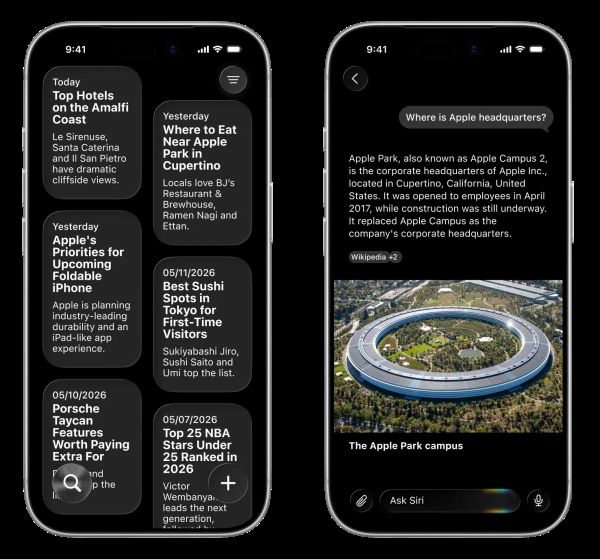
Apple is said to be preparing a new Siri that integrates artificial intelligence features across the iPhone operating system, along with a separate Siri application.
Foreign media, including tech outlet TechCrunch, reported on May 28 that leaked renderings released ahead of the Worldwide Developers Conference (WWDC) outline a revamped Siri designed to compete with AI chatbots such as ChatGPT.
The core idea is to expand Siri from a simple voice assistant into the iPhone's default search and execution interface. Users can still summon Siri with a button, but responses and animations are designed to appear in the Dynamic Island at the top of the iPhone. The approach is optimised for quick voice queries and simple searches.
A new search mode is also expected. The method of opening Spotlight search by swiping down on the screen would remain, but the search results are expected to be handled by an AI-based Siri. Siri would run on a rebuilt AI model and is reported to use some of Google Gemini AI technology internally. The existing search bar would remain, with AI responsible for generating results and carrying out commands.
In this interface, Siri would handle not only searches but also launching apps, sending messages, checking weather, adding calendar events, searching notes and running app shortcuts. Results would be provided as structured text in card form and linked with the Dynamic Island. Apple appears to be repositioning Siri not as a standalone feature but as a default tool embedded across the operating system.
Apple is also said to be preparing a separate Siri app. The app is reported to allow users to view past conversations and to support not only text input but also document and photo uploads. The move points to a strategy to expand Siri into a standalone AI chatbot service competing with ChatGPT, Anthropic's Claude and Gemini.
Siri's processing structure is also set to change. The new Siri is expected to be designed as a hybrid structure that combines on-device processing on the iPhone with cloud processing. Apple has long stressed that on-device AI processing is advantageous for privacy, but some principles appear to have been relaxed in this overhaul.
The shift reflects smartphone hardware limits. While the latest chips are improving AI performance, there are significant constraints in fully running large language models (LLMs) on devices. Smartphones lack enough RAM to load large models fully into memory, and on-device models are limited to billions of parameters. By contrast, the latest Gemini models are said to use trillions of parameters. Device models also go through a quantisation process to improve speed, but that process can affect token-generation accuracy.
Google also has Gemini Nano, a lightweight model for mobile devices, but it is optimised for limited functions such as context summarisation and audio processing. Siri, by contrast, has strong characteristics of an interactive assistant that receives user requests and performs actual tasks.
Apple is therefore reported to have applied a distillation method that miniaturises Google's large, cloud-based Gemini models. The method lets a smaller model learn and reproduce some performance of a larger model. Apple is seen as aiming to build a structure in which simple requests are handled on the device, while complex requests are sent to the cloud.
Limits in Apple's own cloud infrastructure have also been cited. Apple has built a Mac M-series chip-based 'Private Cloud Compute' system, but it is reported to be burdensome to run large Gemini models stably. As a result, some complex requests are processed on Google Cloud rather than Apple's infrastructure.
Nvidia is expected to play an important role in this process. Apple is reported to have signed a deal to use Nvidia's 'confidential computing' platform instead of Google's TPUs. The technology keeps data encrypted within graphics processing units even while it is processed in the cloud. That would allow Apple to increase reliance on the cloud while maintaining its privacy stance to some extent. There is also speculation that the existing Private Cloud Compute brand could be retained for this system.
Apple's biggest advantage in market competition is its vast user base. ChatGPT has about 900 million weekly active users, while Apple's installed base across all devices, including iPhones, totals about 2.5 billion units. Apple can expose AI functions directly through Siri to a large pool of users who do not use separate AI services.
Ultimately, this Siri overhaul is closer to Apple's AI distribution strategy than a simple feature addition. It would lower barriers by integrating Dynamic Island, Spotlight search and a separate chatbot app into a single user flow. If an announcement at WWDC follows this direction, Siri is likely to be redefined not as a voice assistant but as the iPhone's AI gateway.
 Seung-a Yoo
ysah@d-today.co.kr
Seung-a Yoo
ysah@d-today.co.kr