
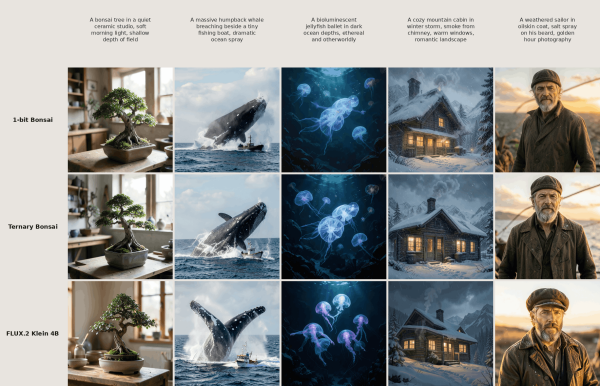
[Digital Today reporter Jinju Hong (홍진주)] Prism ML has unveiled an image-generation artificial intelligence (AI) model, Bonsai Image 4B, that can run locally on an iPhone.
On May 27 local time, online media outlet Gigazine reported that the key is sharply reduced memory use by lightening an existing image-generation model, FLUX.2 Klein 4B, so it can run on smartphones.
The release aligns with the trend of competition in on-device AI. Prism ML has developed technology to cut memory use by using quantisation methods that train AI models with two values, -1 and 1, or three values, -1, 0 and 1. The company also introduced in April an 8 billion-parameter language model that can run on an iPhone, 1-bit Bonsai 8B.
Bonsai Image 4B is a model retrained from FLUX.2 Klein 4B. Prism ML released two versions as open models: 1-bit Bonsai Image 4B, which uses only -1 and 1, and Ternary Bonsai Image 4B, based on -1, 0 and 1.
The drop in memory use is large. The original FLUX.2 Klein 4B requires about 7.75GB, but 1-bit Bonsai Image 4B is reduced to 0.93GB and Ternary Bonsai Image 4B to 1.21GB. Prism ML explained that it maintained generation quality to a significant degree after lightening. By the company’s standards, image quality versus the original is 88 percent for the 1-bit model and 95 percent for the three-value model.
It also released the actual way to use it. Prism ML distributed a free iPhone app, Bonsai Studio, on the App Store, and users can download the model after running the app and generate images immediately. By the outlet’s measure, the Bonsai ternary model file size was about 3.89GB.
Generation speed was also disclosed. Based on the iPhone 17 Pro, it took about 12 seconds to generate a single 512 by 512 pixel image. The outlet introduced an example of entering prompts such as “broccoli bonsai, Japanese garden, photoreal” to generate desired images. Animation-style images or images of people could also be generated in the same way.
The model is not exclusive to iPhones. Prism ML said Bonsai Image 4B can also run in Windows 11 PC and macOS environments. The model is being distributed publicly through Hugging Face.
The industry sees the release as meaningful because lightening has advanced to a level where image-generation AI can run on a smartphone without a network connection. It is drawing attention in particular for lowering memory use to around 1GB while letting general users try it directly through a free app. That raises the possibility that competition in on-device AI could quickly expand from text generation to image generation.
 Jinju Hong
hongjj@d-today.co.kr
Jinju Hong
hongjj@d-today.co.kr