
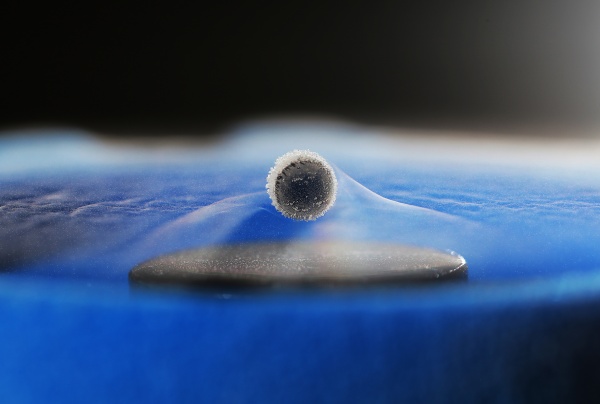
A U.S. research team has raised the superconducting transition temperature under ambient pressure to about minus 122 degrees Celsius, breaking a record after 33 years.
Online media outlet Gigazine reported on May 28 that a team at the University of Houston and the Texas Center for Superconductivity said it achieved a superconducting transition temperature of 151 kelvin, about minus 122 degrees Celsius, at ambient pressure using Hg1223, a mercury-based copper-oxide ceramic. The figure is 18 kelvin higher than the previous record of 133 kelvin.
Superconductors are materials whose electrical resistance becomes zero below a certain temperature. A higher transition temperature can reduce cooling costs and equipment burdens, increasing the potential for practical use. Many high-performance superconductors maintain their properties only under ultra-high pressure, limiting industrial applications, and the new result is significant because it raises the record under normal atmospheric pressure.
The team attributed the record to a “pressure quench” technique. The method keeps a material’s structure and electronic state formed under high pressure even after the pressure is removed. The researchers applied strong pressure to Hg1223 to strengthen superconducting properties, then quickly removed the pressure while the material was cooled to a certain temperature. They said the superconducting properties formed under high pressure were maintained at ambient pressure as a result.
The experiment used pressure up to 300,000 times normal atmospheric pressure. The team said the 151 kelvin transition temperature remained for about two weeks after the pressure was removed, and the same result was reproduced in five different samples. Chinhyu Chu (친우 추) of the University of Houston, who led the research, said the approach “showed the possibility of maintaining at ambient pressure properties that are possible only under high pressure.”
A large gap still remains to an ambient-pressure, room-temperature superconductor. The new record is about minus 122 degrees Celsius, around 140 degrees away from typical room temperature. The team also drew a line, saying the result does not mean room-temperature superconductivity will be achieved immediately. Even so, it is assessed as progress in cutting cooling costs and expanding potential applications because it raised the ambient-pressure record after 33 years.
Superconductors are seen as a key technology in areas including power transmission, MRI, nuclear fusion, quantum computing and high-speed electronic devices. Chu stressed that power loss during transmission is substantial and that wider use of superconductors could help improve energy efficiency and ease environmental burdens.
The industry is also watching the possibility that the research could re-ignite competition to develop ambient-pressure superconductors. Key tasks are expected to include whether the pressure-quench effect can be maintained for longer, whether the same approach applies to other materials, and whether the transition temperature can be raised further at ambient pressure.
 Jinju Hong
hongjj@d-today.co.kr
Jinju Hong
hongjj@d-today.co.kr