
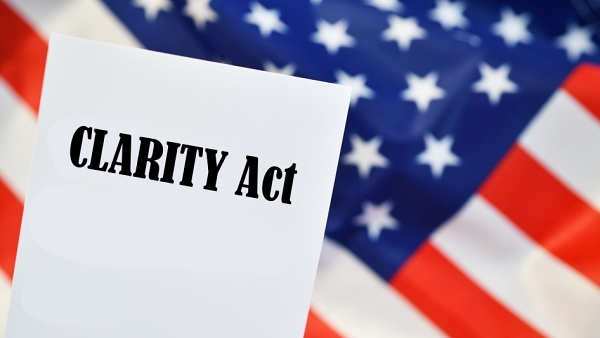
U.S. President Donald Trump reiterated his position that the United States should lock its cryptocurrency market regulatory framework into law so it cannot be overturned by a future change of government or political shifts.
On May 28 local time, blockchain outlet Cryptopolitan reported that Trump stressed he would make U.S. digital asset rules “future-proof” and again mentioned the need to institutionalise them through legislation in Congress.
The core of the remarks is legislation, not the administration’s policy line. The current pro-crypto policy in the United States relies heavily on changes in enforcement direction by the heads of regulatory agencies appointed by Trump. Critics have long pointed to a limitation: if the next administration replaces personnel or changes enforcement priorities, existing policy could be shaken again. Trump directly mentioned the need to “codify” it in law for that reason. It means the regulatory framework must be fixed in the form of legislation passed by Congress to be maintained regardless of a change in government.
On his social media platform Truth Social, Trump claimed former U.S. Securities and Exchange Commission Chairman Gary Gensler and anti-crypto forces pushed bitcoin and crypto innovation overseas. He said that since the launch of his administration the United States is again “becoming the crypto capital of the world, and developers and entrepreneurs are returning to the U.S. market.” He then said he would make into law an irreversible, future-proof digital asset market structure and stressed, “I will never let crypto down.”
The reason Trump again targeted Gensler is also clear. Gensler led the SEC from 2021 to early 2025 and filed a series of lawsuits against major crypto companies including Coinbase, Binance, Ripple and Kraken. At the time, the SEC judged many tokens to be unregistered securities and sought to regulate them within the existing securities law framework. The industry has argued that excessive regulatory pressure continued when a suitable registration framework effectively did not exist, and that as a result, companies and capital moved to markets with clearer regulation such as Dubai, Singapore and London.
The mood has now changed. Under Paul Atkins, the SEC has largely rolled back the enforcement-focused approach of the Gensler era, and the U.S. Commodity Futures Trading Commission is pushing to expand its influence in crypto and prediction markets. The Justice Department has also dropped some pending crypto cases. Still, these changes are also based on the policy direction of the administration and the heads of regulatory bodies, prompting criticism that without legislation it is difficult to secure long-term durability.
Against this backdrop, market attention is turning to the CLARITY Act. The bill sets criteria for which crypto assets are treated as securities under SEC jurisdiction and which are classified as commodities under the CFTC. It also includes legal procedures for companies seeking to provide crypto services to U.S. customers, protections for decentralised software developers, and principles for handling customer funds when crypto firms go bankrupt.
The legislative process is not yet complete. The House passed the bill last July, and the Senate Banking Committee held a vote on amendments this month. But for it to become final law, it must pass the full Senate and be signed by the president. The White House has presented July 4 as a target date, but in political circles there is also an assessment that the schedule is very tight.
Ultimately, analysis says the success or failure of the “future-proof” crypto regulatory framework Trump referred to depends not on the pro-industry stance itself but on whether it can be codified in law. If the boundary between SEC and CFTC jurisdiction, standards for companies operating in the United States, and a customer fund protection framework are confirmed through legislation, the U.S. crypto market will have a more stable institutional foundation regardless of changes in government. If it fails to clear the Senate hurdle, the current easing of regulation may still be subject to renewed volatility depending on the administration’s judgment.
 Jinju Hong
hongjj@d-today.co.kr
Jinju Hong
hongjj@d-today.co.kr