
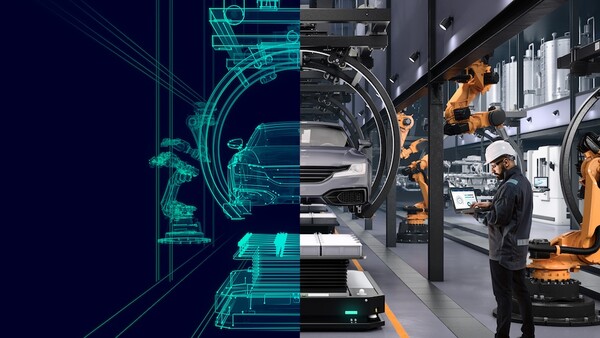
South Korea's Ministry of Science and ICT said on Wednesday it will begin piloting 12 innovative services that combine artificial intelligence (AI) with virtual convergence technologies such as digital twins and extended reality (XR), starting this month.
Virtual convergence technologies such as digital twins and XR are drawing attention as tools to deliver AI-based services effectively and as spaces to predict and test future situations. Through two programmes, "Digital Twin Leadership in AI-Based Safety Management" and "Fostering AI-Based Virtual Convergence Industries," the ministry will identify services in the areas of safety, industry and daily life.
The "Digital Twin Leadership in AI-Based Safety Management" programme will demonstrate 6 tasks in disease, daily-life and industrial safety.
In disease safety, it will build a decision-support system that can pre-test quarantine measures in the event of an outbreak of highly pathogenic avian influenza at a poultry-dense complex in Gimje, North Jeolla Province. At Bestian Hospital in Cheongju, it will develop and apply a platform that simulates pathogen spread and also controls air-conditioning systems.
In daily-life safety, it will demonstrate an AI-based system to predict and detect gas-leak risks at 4 city-gas pressure regulator sites in Daejeon. The goal is to shift risk assessments that relied on workers' experience to a data-based automatic classification system. On Jeju Island, it will demonstrate a service that analyses groundwater levels and rainfall to predict areas at risk of flooding and drought.
In industrial safety, it will build a platform at Korea Southern Power plants to detect gas and pollutants early and visualise their spread paths. At a plastics factory in Dangjin, it will put in place a system that derives optimal fire-evacuation routes and detects risks in real time based on autonomous patrol robots.
The "Fostering AI-Based Virtual Convergence Industries" programme will also demonstrate 6 tasks in industry and daily-life areas.
In industry, it will introduce digital twin-based optimisation for robot painting and an AI quality inspection system for the automotive coating process at Namseon Aluminum in Gumi. At Busan New Port's Shinsundae-Gamman Terminal, it will demonstrate an integrated control system that includes port crane operation optimisation and maintenance guides, and at HD Hyundai Samho's shipyard in Mokpo it will build an integrated control platform that manages processes by analysing the inside and outside of ships in 3D.
In daily-life applications, it will develop and demonstrate a spatial intelligence-based tourism service at major tourist sites in Gyeongju, including wheelchair route guidance that considers mobility constraints such as stairs. At Chonnam National University Hospital, it plans to demonstrate an AI-based patient guidance service linked to the hospital information system, and in Incheon it plans to demonstrate a service that automatically identifies locations when people report dangerous situations with photos.
The ministry held a launch report meeting for the "Fostering AI-Based Virtual Convergence Industries" programme on Wednesday. Demand institutions and lead institutions attended to share implementation plans and agreed to take an active role from service development to on-site demonstration to improve programme completion.
Nam Cheol-gi (남철기), director general for software policy at the ministry, said, "When AI is added to virtual convergence technologies, it creates a thinking field that goes beyond simply viewing to predicting risks and finding optimal answers." He said, "We will actively support various ideas that are essential in people's daily lives and on worksites so they can be implemented well."
 Seulgi Son
sageson@d-today.co.kr
Seulgi Son
sageson@d-today.co.kr