
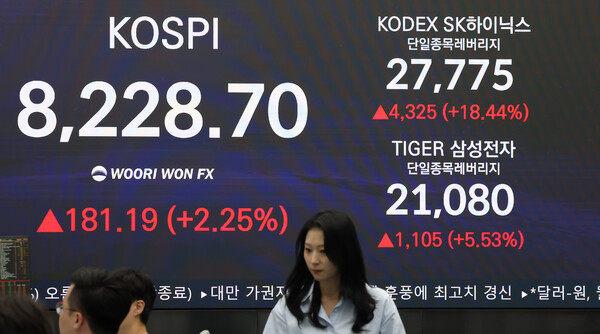
As the KOSPI extends gains, including rising above the 8,000 level, the market capitalisation of exchange-traded funds (ETFs) listed in South Korea has topped 500 trillion won for the first time.
According to the Korea Exchange and others on May 27, the combined market value of 1,132 ETFs listed on South Korean markets stood at 501.1 trillion won as of that day.
It marks the first time the domestic ETF market has exceeded 500 trillion won since ETFs were first listed on the main stock market in October 2002, 24 years ago.
The ETF market is expanding quickly as recent stock gains coincide with inflows of investor funds. Domestic ETF market capitalisation topped 100 trillion won in June 2023 and exceeded 200 trillion won in June 2025. It then passed 300 trillion won on Jan. 5 this year and reached 400 trillion won on April 15.
In 42 days, it added another 100 trillion won to enter the 500 trillion won range. The KOSPI’s strong trend above 8,000 is seen as boosting demand not only for index ETFs but also for growth-themed ETFs tied to semiconductors, artificial intelligence (AI), robots and electricity.
As the market expands quickly, the number of products has also jumped. The number of ETFs listed in South Korea has topped 1,000 and now stands at 1,132. Asset managers are widening investor choice by offering a range of products, including key domestic and overseas indexes, bonds, monthly dividend payouts, themed offerings, and leverage and inverse products.
The growth of the ETF market is also linked to structural changes in South Korea’s capital market. As ETFs take hold as tools for asset allocation, theme investing and long-term pension investing, growth in the market is accelerating beyond a focus on direct stock investing.
With more ETFs featuring complex structures, investors need to sufficiently check factors such as the underlying index, fees, tracking error, premium and discount rates, and whether the product uses leverage.
In particular, volatile themed or leveraged products such as the single-stock leveraged ETF for Samsung Electronics and SK Hynix launched on May 27 may carry greater loss risk than standard index ETFs.
 Sangyeop Oh
yub@d-today.co.kr
Sangyeop Oh
yub@d-today.co.kr