
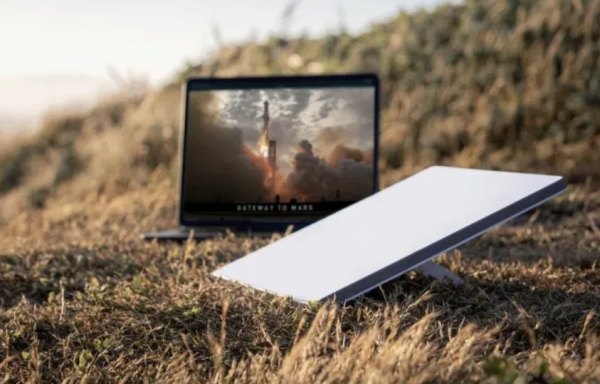
[DigitalToday intern reporter Kyung-min Hong (홍경민)] SpaceX is preparing to launch a new, ultra-compact Starlink Mini satellite internet antenna with a built-in battery that can operate without a separate power connection.
On May 26 (local time), IT outlet The Verge reported that analysis of Starlink’s latest firmware source code recently turned up a series of specific clues suggesting a battery-integrated model could be released. The discovery is expected to significantly improve the wireless portability of low-Earth-orbit satellite internet service, which has so far required a constant external power connection.
Jinwei Zhao (진웨이 자오), a university researcher, first found multiple command strings hinting at a built-in battery in a Starlink firmware version distributed in May. The source code was confirmed to include specific system lines for checking the status of an integrated battery.
The most notable source code is a specific line called message DishBatteryStats. This system line is designed to call detailed field values of an integrated battery from the antenna’s internal system. It clearly includes charge status data indicating the battery’s remaining level.
If the satellite antenna were simply wired to an external third-party brand power bank, the Starlink system itself would be unable to read an accurate charge percentage. The fact that the hardware can fully identify the battery’s current charge percentage or charge status through its own system is clear evidence that a power source is directly built into the device.
The firmware source code also defines code indicating three different independent power supply states. This suggests the new Starlink Mini antenna supports operation through a direct external wired power source, operation using its built-in battery, or operation using both power sources at the same time.
This simultaneous power supply method would fully provide a pass-through function in the device. Pass-through technology supplies power directly to the device without routing it through the battery when external power is connected, reducing charge and discharge cycles and extending battery life. This can prevent an expensive satellite antenna from becoming unusable due to battery aging after hundreds of charge and discharge cycles.
Existing Starlink Mini models currently on the market must be connected to external power to exchange signals with a constellation of more than 10,000 satellites operating in low Earth orbit. Users have operated the antenna by plugging it into a household AC wall outlet or wiring it to a separate portable power bank.
A dedicated PeakDo battery product that mounts to the back of the antenna has previously been released. But the PeakDo product has been criticized for very unstable software that makes performance less smooth, and it has also been cited as excessively expensive compared with general external power banks with similar specifications.
If SpaceX releases an official new Starlink Mini product with a built-in battery, the software instability and price burden associated with existing third-party products are expected to be largely resolved. In particular, it is highly likely to offer stable integration with the official Starlink mobile application, as well as official manufacturer warranty and after-sales support.
With the power supply integrated inside the hardware, the exterior design is also expected to become simpler. This could enable a product that strengthens portability and ease of use at the same time.
Meanwhile, the new all-in-one device is widely expected to carry a battery that meets carry-on standards for aircraft cabins. It is also analyzed to provide enough power, based on users’ real-world operation tests, to run satellite internet continuously for several hours outdoors without any separate external power connection.
A Starlink Mini with a battery and full wireless portability is expected to open up an environment where high-speed, low-latency internet can be used anywhere in the world. It is also seen as an optimal solution that could maximize mobility for van lifers living in vehicles as well as rescue workers at emergency disaster sites where a stable independent power source is essential.
 Kyung-min Hong
hongm@d-today.co.kr
Kyung-min Hong
hongm@d-today.co.kr