
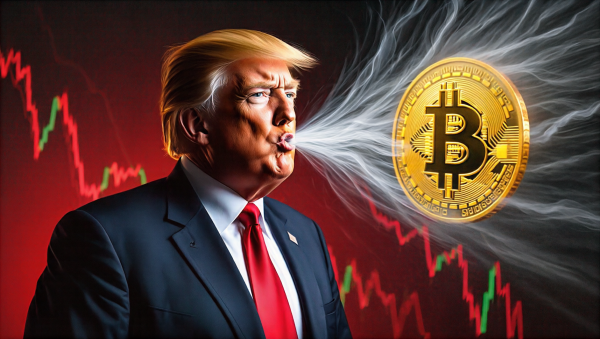
[DigitalToday reporter Yoonseo Lee] U.S. President Donald Trump is found to have wide-ranging interests across cryptocurrencies, including a personal wallet, a DeFi platform, memecoins and corporate bitcoin holdings.
On May 26 (local time), blockchain outlet The Crypto Basic said it is hard to find a precedent in which a sitting U.S. president leads national crypto policy while holding such diverse digital-asset interests.
Trump's crypto interests are divided among a personal wallet and World Liberty Financial (WLFI), memecoins named after the Trump family, and a bitcoin-holding strategy by Trump Media and Technology Group (DJT). Financial disclosure documents list Trump as holding an Ethereum wallet worth $1 million to $5 million. But the exact balance, wallet address and full transaction history have not been disclosed.
The value of a Trump-related wallet disclosed by on-chain tracking firm Arkham Intelligence fell sharply during 2025. The wallet dropped to $939,590 on Dec. 31, 2025, from $10.16 million on Jan. 1 that year. It has now fallen further to about $623,000. The largest remaining holdings were TROG, USDC and WeFi, while TRUMP was tallied at about $20,000 and ether at about $14,000. TROG is a memecoin featuring a frog wearing a MAGA hat, and is cited as an asset showing cases in which outside users send tokens arbitrarily to politicians' wallets.
At the centre of the controversy is WLFI. WLFI, an Ethereum-based DeFi platform launched in September 2024, raised more than $550 million through token sales and is known to have generated about $1 billion in profit for the Trump family. The entity tied to the project is structured to receive 75 percent of net proceeds from WLFI token sales and part of stablecoin-related revenue.
Criticism has followed. Eswar Prasad (에스와르 프라사드), a Cornell University professor, called it surreal and said outside investors are not sufficiently sharing in the results while the Trump family profits from a business with high conflict-of-interest concerns.
WLFI has also faced complaints over its price and distribution structure. Justin Sun (저스틴 선), founder of Tron, invested $75 million after Trump's election victory. WLFI was first sold at $0.015 in October 2024, and was sold at $0.05 in a second offering in early 2025. But its current price is about $0.06, about 87 percent below its peak of $0.46. As of May 2026, investors who bought at $0.05 have still been unable to dispose of 80 percent of their holdings.
Memecoins promoted under the Trump brand are also cited as a factor that increased market volatility. The Solana-based memecoin "Official Trump" (TRUMP) rose above $75 within two days after its Jan. 17, 2025 launch, pushing its market capitalisation above $14.5 billion. Its current price has fallen to around $2.04. Of the total supply of 1 billion tokens, 800 million are held by Trump-linked companies CIC Digital LLC and Fight Fight Fight LLC, and were designed to be released sequentially over 3 years.
Regulatory and ethics controversies are also continuing. The Senate Permanent Subcommittee on Investigations launched a formal probe earlier this month, requesting materials related to ethics issues from Fight Fight Fight LLC. Senator Elizabeth Warren previously criticised the TRUMP coin, saying it "made Trump personally wealthy on a massive scale and opened a channel for the crypto industry to funnel money to him."
MELANIA, named after Melania Trump, showed a similar pattern. The token surged immediately after its Jan. 19, 2025 launch, at one point recording an implied value of more than $8 billion. It later plunged, and its market capitalisation is now about $88.45 million. Questions were raised that one wallet may have held up to 89 percent of the supply at launch, and it was also criticised for lacking a decentralised governance structure.
Corporate-level bitcoin exposure is also large. DJT announced in July 2025 that it held about $2 billion in bitcoin and related securities. As of March 2026, its holdings were 9,542.16 BTC and 756.1 million CRO. DJT stock is also mentioned as an indirect way to invest in bitcoin, but the company is estimated to have an unrealised loss of about $455 million after buying 11,542 BTC at an average of $118,522. Its net loss in the first quarter of 2026 also reached $400.59 million.
Another pillar linked to the Trump family is bitcoin mining company American Bitcoin (ABTC). The company, established in March 2025 by mining firm Hut 8, received support from Eric Trump and Donald Trump Jr. It currently holds 7,500 BTC. In March 2026, it laid out a plan to add 11,298 ASIC miners at its Drumheller, Alberta facility, raising mining capacity by about 12 percent.
This business expansion is fuelling controversy as it intersects with the Trump administration's pro-crypto policies. Trump signed an executive order on March 6, 2025 to establish a strategic bitcoin reserve and a U.S. digital asset stockpile. David Sacks (데이비드 색스), the White House AI and crypto czar, described it as a "digital Fort Knox" for crypto. The administration also pursued a ban on developing a U.S. central bank digital currency (CBDC) and pushed to establish a dedicated task force under the U.S. Securities and Exchange Commission (SEC).
Policy changes were quickly reflected in the market. Bitcoin broke above $90,000 within weeks after the November 2024 election victory. In contrast, concerns over conflicts of interest surrounding Trump-related projects also grew. In particular, it is being mentioned together that a company linked to the Abu Dhabi government bought a 49 percent stake in WLFI for about $500 million, and that the United States later approved a plan allowing the United Arab Emirates (UAE) access to advanced semiconductor chips.
From an investor perspective, structural risks are also clear. TRUMP has fallen more than 97 percent from its peak, MELANIA about 99 percent, and WLFI about 89 percent. All 3 projects have supply concentrated in Trump-linked entities, leading to criticism that the structure favours insiders over ordinary investors. The Senate Permanent Subcommittee on Investigations, led by Democratic Senator Richard Blumenthal, is examining Trump's crypto businesses including TRUMP and WLFI for foreign money inflows, insider trading and possible violations of the presidential conflicts-of-interest clause.
Trump-linked cryptocurrencies are unusual in that they combine a personal wallet, DeFi, memecoins and a corporate bitcoin-holding strategy at the same time. As policy decision-making power and direct digital-asset interests intersect, both market structure and ethics controversies have come into focus.
 Yoonseo Lee
yslee@d-today.co.kr
Yoonseo Lee
yslee@d-today.co.kr