
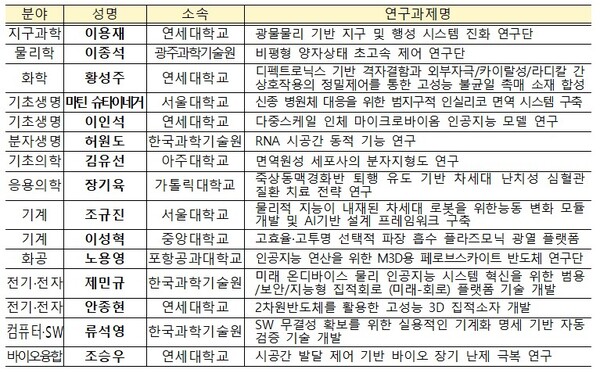
The government has newly selected 18 leading domestic basic researchers to conduct world-class research.
The Ministry of Science and ICT said on Tuesday it announced the 2026 Basic Research Programme Leader Research selection results and will start providing support from June 1.
The Basic Research Programme supports researchers and research groups in science and engineering fields so they can build creative basic research capabilities and deepen and develop their work. SCIE papers produced through the programme accounted for 37 percent of the country's total SCIE paper publications as of 2023, contributing to the development of academic research in South Korea's science and technology fields.
Leader Research began in 1997. It provides long-term support for 9 years by selecting world-class researchers so they can continue advanced research and produce strong research results. The support categories consist of Type A, which provides 800 million won a year per researcher, and the newly introduced Type B (top-tier) this year, which provides 1.6 billion won a year.
This year, 15 researchers were selected for Type A and 3 for Type B after expert discussion reviews and researcher presentation evaluations. The latest selection includes Geun-soo Kim (김근수), a Yonsei University professor (Type B, physics), Young-seok Joo (주영석), a Korea Advanced Institute of Science and Technology professor (Type B, basic medicine), and Martin Steinegger, a Seoul National University professor (Type A, basic life sciences). Many researchers born in the 1980s were selected, raising expectations for younger researchers' activity in the basic research field.
Sung-soo Kim (김성수), director-general for research and development policy at the ministry, said long-term and stable support is important so researchers can focus on their work to improve basic research capabilities. He said the ministry will actively support Leader Research, which significantly increased its funding scale this year, so it can contribute to the development of science and technology and strengthening international competitiveness.
 Jin-ho Lee
jhlee26@d-today.co.kr
Jin-ho Lee
jhlee26@d-today.co.kr