
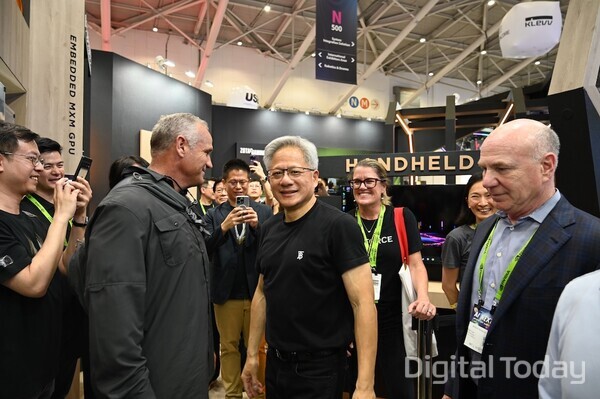
[Digital Today reporter Daegeon Seok] The official theme of "Computex 2026," to be held in Taipei from June 2 to 5, is "AI Together." The event will feature 1,500 companies running 6,000 booths, with AI computing, robotics and next-generation technologies positioned as the three main areas. But another issue is weighing on the event. It is a battle to secure supplies of high-bandwidth memory (HBM4) for next-generation AI accelerators and the market’s standoff over volatility in DRAM and NAND prices.
The keynote lineup itself is being interpreted as an event that makes memory demand more visible. Nvidia CEO Jensen Huang will deliver a standalone keynote at Taipei Music Center at 11 a.m. on June 1. Nvidia said it plans to unveil a "Five-Layer Cake" approach "from energy to applications." Key topics include the next-generation "Rubin" GPU ecosystem, Physical AI and agentic systems. At 2 p.m. the same day, Qualcomm CEO Cristiano Amon will give the opening keynote to unveil a Snapdragon-based AI PC platform and an edge-computing blueprint.
A keynote drawing particular attention is the stage appearance by Marvell Chairman and CEO Matt Murphy at 10:30 a.m. on June 2. TAITRA, the organiser of Computex, said Nvidia CEO Jensen Huang will make a surprise appearance at the session. Murphy’s topic is "The Future of AI Depends on Connectivity." TAITRA explained that the two companies will discuss ways to offer customers more choice and flexibility in developing next-generation AI infrastructure, based on a partnership announced in March. Intel CEO Lip-Bu Tan’s keynote at 1:30 p.m. the same day closed early for general registration, with Xeon 6 for data centres and the Core Ultra Series 3 (Nova Lake) for next-generation AI PCs placed front and centre.
Above all, the biggest memory demand is from Nvidia. According to Yuanta Securities, Nvidia posted fiscal 2027 first-quarter (FY1Q27) revenue of $81.6 billion, up 85.2 percent from a year earlier. Data centre revenue came to $75.2 billion, and AI Cloud Infrastructure (ACIE) revenue rose 31.1 percent from the previous quarter to $37.4 billion. Yuanta Securities analysed that explosive growth in AI-native cloud and sovereign AI drove quarterly growth. The Rubin ecosystem roadmap to be announced during Computex will be directly linked to making HBM4 absorption more visible.
Supply-side signals are also expected to be shown in earnest at Computex. According to Shinhan Investment Corp, 2026 demand growth for DRAM and NAND is estimated at 23.6 percent and 18.1 percent, respectively, exceeding supply growth by 2.1 percentage points and 4.7 percentage points. Supply constraints sparked in server memory are spreading to general-purpose memory. Shinhan Investment said the visibility of memory growth is "the clearest" across past cycles and analysed that repeated record-high results are likely to continue through the later part of the cycle.
◆ South Korea’s memory industry faces Computex messaging as a variable
The placement of Computex forum sessions makes clear where the weight of attention is centred. On June 4, in the "AI Computing Infrastructure" track, Western Digital (WD) Chief Product Officer Ahmed Shihab will present on "reinventing storage for AI scale," and Kioxia technology executive Koichi Fukuda will speak on "the key role of SSDs."
Solidigm Vice President Aiv Shetty is set to deliver the message that storage has evolved from secondary to essential as retrieval-augmented generation (RAG) pipelines and the spread of KV cache expand. ZEISS will unveil chip-to-rack quality solutions spanning HBM, PCBs, immersion cooling and co-packaged optics (CPO) connectivity.
Power and cooling agendas are also directly linked to memory supply and demand. Nvidia Senior Vice President of Networking Kevin Deierling will announce co-design with Taiwan’s ecosystem in an "AI Factory" session the same day. Infineon, Schneider Electric, Supermicro, Dow and Monolithic Power Systems will unveil immersion cooling and high-density power delivery technologies. That means data centre power and heat thresholds have become a variable that will determine the speed of HBM4 adoption.
The key question is whether big tech demand blueprints and HBM4 mass-production schedules disclosed at Computex will align. The larger the messages that will pour out over three days, including Nvidia’s Rubin roadmap, Intel’s Xeon 6, Qualcomm’s AI PC and Marvell-Nvidia connectivity collaboration, the more intense the market’s standoff over DRAM and NAND prices is expected to become.
Yuanta Securities analysed that Nvidia CEO Jensen Huang’s June 1 presentation ahead of the Taiwan Computex event and positive momentum in the global semiconductor value chain are likely to continue. At the same time, it forecast that the mass-production ramp-up of next-generation HBM products will get under way in earnest in a tight global memory supply-demand environment.
 Daegeon Seok
d2dg@d-today.co.kr
Daegeon Seok
d2dg@d-today.co.kr