
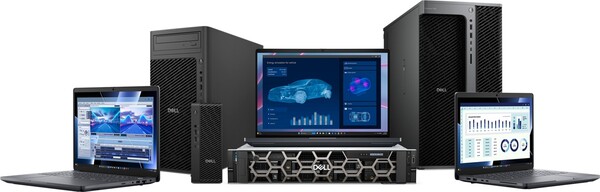
As more companies put AI into real-world use, demand is also growing for AI infrastructure that can cover AI workloads inside corporate environments rather than in the cloud.
Cloud-based AI strategies alone have limits in terms of cost, data sovereignty and privacy. A narrative is also spreading that a hybrid model combining the cloud with a company’s own infrastructure is a realistic approach.
According to the related industry, companies view a hybrid strategy that combines the strengths of on-premises and the cloud as important from the standpoint of data and cost management, rather than simply moving away from the cloud.
Amid this, interest has also risen in workstations, which have stronger hardware performance and stability than general PCs. Workstations can meet all three factors companies cite as important when adopting AI: cost, speed and security, the industry says, increasing their role as corporate AI infrastructure.
Workstations can run autonomous AI agents without exporting data outside. They can also convert volatile cloud costs into predictable infrastructure investment. When choosing where to deploy AI workloads in the workplace, key factors include data sovereignty and regulatory compliance, AI development speed and agility, and scalability and resource flexibility. This shows there is more room for workstations to gain ground.
Workstation usage is rising across all stages of AI development. A forward-looking computing report published jointly by Dell, Intel and market research firm IDC found usage rates of 62 percent in the data preparation stage, 60 percent for foundational model training, 59 percent for model fine-tuning, 44 percent for AI deployment and 29 percent for inference.
An IDC survey found 72 percent of South Korean companies expect the number of workstations they own to increase over the next 5 years. They cited "data security and personal information protection" and improved business agility through on-site AI inference without latency as advantages of running local AI on workstations. In the same survey, 97 percent of Asia-Pacific companies agreed that workstations are high-performance innovation devices that strengthen teams’ capabilities to explore cutting-edge technologies such as AI and ML.
Workstations are advantageous for meeting industry regulations and personal information protection requirements in sectors such as healthcare, finance and government by processing data directly inside an organisation without exposing it to external networks.
Because they can process work on site, they also have an advantage in terms of speed. According to IDC, 94 percent of organisations in the Asia-Pacific region, including 93 percent in South Korea, agreed that workstation users are more productive than non-workstation users for compute-intensive, AI-related work.
Dauntless XR, which provides extended reality ("XR") solutions that turn data in the aviation and space sector into intuitive 3D visual materials, adopted Dell high-performance workstations. It shortened compile time by 85 percent, improved AI model training speed by 150 percent and reduced user data processing time to 30 seconds from 3 minutes.
Moves by the related industry are also accelerating for workstations aimed at AI workloads. Dell Technologies is focusing on offering a workstation lineup that can be selected according to AI workload characteristics and organisational operating environments.
The Dell Pro Max Tower T2 supports high-performance workloads such as complex AI model training, data analysis and 3D rendering based on the latest Intel Core Ultra processors and enterprise-grade GPU options.
The Dell Pro Precision 7 16 is a mobile workstation. It is equipped with a high-performance CPU and professional GPU to support high-spec workloads such as AI development, CAD design, content creation and data analysis while on the move.
Gartner forecasts that by 2026, a significant share of the causes of failures in corporate AI projects will stem from inadequate infrastructure and a lack of governance. This means modernising IT policy has emerged as a key condition for AI ROI.
The same applies to workstation adoption. A Dell-IDC report said Asia-Pacific companies cited "company IT policy or standards" as the biggest obstacle to "workstation adoption."
As for why companies do not adopt workstations, 41 percent said their main PC supplier does not supply workstation products. Another 21 percent cited an "unclear value difference between workstations and PCs," while 16 percent pointed to "concerns about high costs."
The related industry stresses that, from a total cost of ownership perspective, workstations are not "expensive equipment." Contrary to preconceptions about initial costs, it says workstations provide high long-term ROI through durability, reduced maintenance costs and control of computing costs, meaning predictable expenses. There is also analysis that workstations have an advantage as a one-time capital expenditure investment in terms of economic efficiency compared with ongoing cloud GPU costs.
In an IDC survey, 63 percent of Asia-Pacific companies said they plan to increase the share of workstations among total devices over the next 5 years. Jacinta Quah (자신타 콰), vice president of Dell’s Asia Pacific, Japan and China region client solutions group, said: "The future of enterprise AI is not a showdown between endpoints and the cloud, but intelligent distribution across every layer of computing. That means every workload must run where it can deliver optimal performance suited to its characteristics. In particular, workstations provide powerful performance and control that are essential for specialised and compute-intensive workloads. Workstation strategies and AI strategies are now converging into one. Only organisations that recognise and respond to this trend early will take the optimal position to scale AI."
 Chi-gyu Hwang
delight@d-today.co.kr
Chi-gyu Hwang
delight@d-today.co.kr