
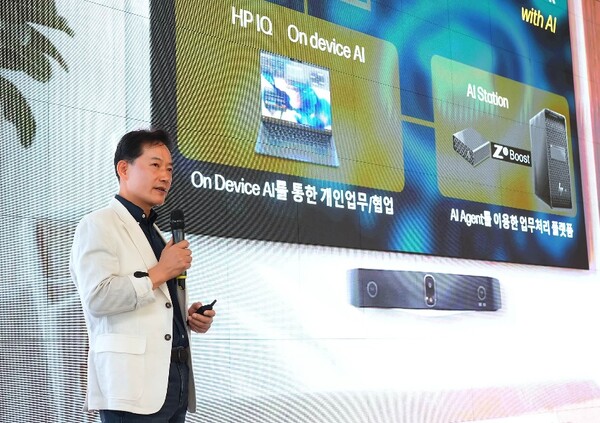
HP has identified "agentic AI" as a core element of the next workplace environment and has moved to lay hardware groundwork to support it. As AI evolves from assisting people to understanding and carrying out tasks on its own, workstations and on-device AI platforms that can handle the computing load have emerged as a new axis of competition. It is an assessment that the competition in AI infrastructure, once centered on the cloud, is moving down to local devices.
HP held a press briefing in Seoul on April 28 to launch new products and unveiled its next-generation AI PC and workstation portfolio and its on-device AI platform, "HP IQ." HP sees AI expanding beyond individual functions into infrastructure running through the entire workflow and released devices and software at the same time to implement that shift.
At the center of the change HP envisions is "agentic AI." HP sees AI evolving beyond automating repetitive tasks toward recognizing situations, supporting decision-making or performing actual work. Moving to this stage requires a computing foundation that can handle large-scale data processing, AI model execution and real-time inference locally. Corporate environments that must reduce dependence on the cloud while securing both security and computing performance are also a condition. That is why HP has redefined the workstation as a "next-generation computing platform" rather than simply a high-performance PC.
That assessment is directly reflected in the desktop workstation "HP Z8 Fury G6i." The product supports up to 4 Nvidia RTX Pro 6000 Blackwell GPUs, enabling it to handle demanding workloads such as AI development, simulation and rendering. HP said it also secured GPU expandability and ease of maintenance through HP Max Side Panel, an industry-first chassis expansion solution. The ability to run 4 GPUs on a single device means companies can perform AI model training and inference without relying on separate servers or cloud resources.
HP also unveiled mobile workstations aimed at on-the-go environments. The "HP ZBook X G2i" and "HP ZBook 8 G2" series are designed to allow 3D design, rendering and AI-based workflows to be carried out outside the office. In particular, the HP ZBook X supports complex project work with up to 128GB of memory and high-performance graphics. HP also presented the "HP Z Boost" solution, which shares GPUs on an on-demand basis to extend the limits of local devices. It said this can boost productivity not only for AI but also for rendering tasks.
Kang Yong-nam (강용남), head of HP Korea, said, "AI is now redefining not just a simple function but the way we work itself." He added, "Based on a portfolio that spans the overall office environment including PCs, printers and collaboration devices, we are creating a 'future of work' in which each device is connected like one intelligent system."
The software pillar paired with the hardware is the on-device AI platform "HP IQ." HP IQ performs tasks such as document summarisation, work automation and file organisation directly on the device. It aims to strengthen security with an on-device structure that does not send data outside and to secure fast responsiveness without delays from cloud round trips.
HP IQ also takes on the role of automatically recognising connections between devices and maintaining a user's work context. The intent is to expand beyond function-level AI into infrastructure running through the entire workflow. So Byeong-hong (소병홍), an executive director at HP Korea, said, "The PC is evolving beyond a simple device into a platform that connects the work experience."
On-device AI 'HP IQ'... Differentiation through security and responsiveness
HP also reshuffled its business PC lineup on the premise of using agentic AI. The "HP EliteBook 6 X G2 AI PC" supports up to 85 TOPS of NPU performance for local AI computing. It supports hybrid work environments with up to 28 hours of battery life and an always-connected function.
HP also unveiled the EliteBook 8 G2 for collaboration users, the EliteBook 6 G2 for corporate and public institutions, the ProBook 4 G2 for small and mid-sized businesses, and the EliteDesk 8 G2 series for desktops. All products apply security functions based on "HP Wolf Security" to support stable operation in corporate environments.
If competition in AI infrastructure has formed around the cloud and data centres, the agentic AI era is likely to bring an expansion in distributed computing to end-user devices. Workstations and AI PCs are expected to become a turning point for the next corporate work environment.
HP plans to continue upgrading AI workstations and its on-device AI platform in line with the full-fledged evolution of agentic AI. The strategy is not to solve all tasks with a single product, but to choose the optimal device according to the work style and role.
 Daegeon Seok
d2dg@d-today.co.kr
Daegeon Seok
d2dg@d-today.co.kr