
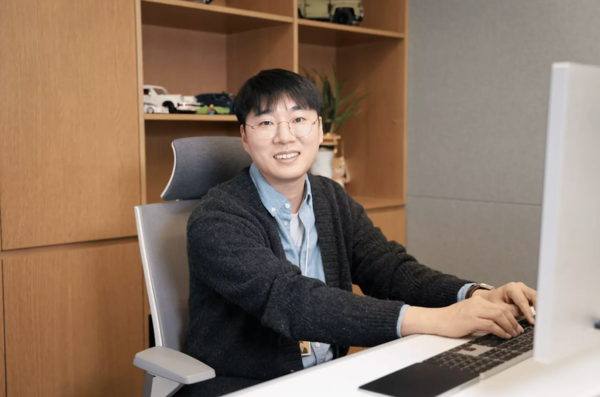
Kakao Mobility unveiled a strategy to internalise Level 4 autonomous driving technology and build an open ecosystem. Kim Jin-gyu (김진규), a vice president at Kakao Mobility and head of its Physical AI division, presented the company’s autonomous driving blueprint on April 22 at the global ICT outlook conference held during the 2026 World IT Show at COEX. He also set out plans for a win-win ecosystem to revitalise South Korea’s autonomous driving industry.
Kakao Mobility said it will combine 3 core elements to improve the completeness of its Level 4 autonomous driving. It will build an autonomous driving machine-learning model that independently performs the entire process from perception, judgement and control. It will introduce vehicles based on redundant design that ensures safety even when key systems fail. It also plans to secure technical completeness by using a vehicle verification platform that circulates virtual simulation and real-world driving data.
To secure service reliability, it will build an "intelligent autonomous driving integrated safety management platform". It will implement a passenger boarding environment with a 3D visualisation solution, AVV (Autonomous Vehicle Visualizer), that shares the vehicle’s view in real time. It aims to complete a safety system that enables remote intervention and initial response in emergencies by developing a 24-hour nonstop control centre and an anomaly auto-alert system based on a visual language model (VLM).
It also announced plans to build an open ecosystem to strengthen the global competitiveness of South Korea’s autonomous driving industry. It will provide extensive autonomous driving training data, high-definition maps (HD Map) and platform APIs such as vehicle calling and dispatch, so startups, academia and manufacturers can focus on advancing their technology. Kakao Mobility will also share its operational know-how and physical infrastructure with partners, including vehicle management solutions and an on-site dispatch system.
Kim said that only when startups, academia and existing industries combine as a single "One-Team" through a mobility platform will services that work in the global market be created. He said the company will continue to lead efforts so South Korea can set global standards in autonomous driving through technological innovation and industry cooperation.
Kakao Mobility also introduced the status of its late-night autonomous vehicle service operating in Seoul’s Gangnam area. The service is linked to mobility services within the Kakao T app, allowing users to use autonomous driving without separate learning.
 Seok Dae-geon
d2dg@d-today.co.kr
Seok Dae-geon
d2dg@d-today.co.kr