
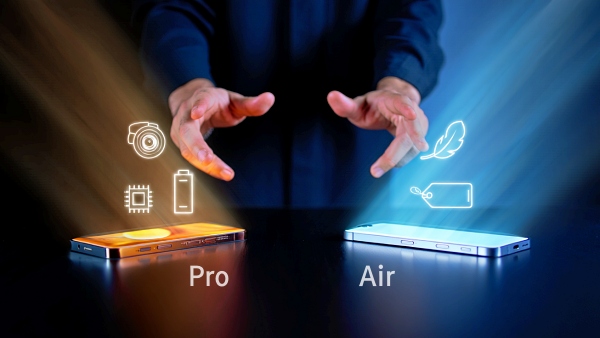
Consumers are split over Apple’s iPhone 17 lineup. Attention is focused on whether to pay an extra 200,000 won for the iPhone 17 Pro, which leads on camera, battery and overall performance, or choose the iPhone Air, pitched as thinner and lighter with a relatively lower price.
On April 20, IT outlet TechRadar reported that the iPhone 17 Pro differentiates itself through overall completeness including camera, battery and heat control, while the iPhone Air stands out with a thinner and lighter design.
Both models were released in September 2025 and come with 256GB of base storage. The iPhone 17 Pro is priced at $1,099 (1.79 million won in South Korea) and the iPhone Air at $999 (1.59 million won in South Korea), a difference of 200,000 won. The iPhone Air is also discounted more often at unofficial retailers, which could widen the perceived price gap.
The biggest difference is the exterior. Measured at its thinnest point, the iPhone Air is only 5.64 mm thick. That is 31 percent thinner than the iPhone 17 Pro and 41 grams lighter. Its display is also larger at 6.5 inches versus 6.3 inches for the iPhone 17 Pro. The thickness difference may not seem significant at first, but it makes a big difference in grip and portability.
There are also differences in materials. The iPhone 17 Pro uses an aluminium frame and a large camera module, while the iPhone Air uses a titanium frame and a glass-focused rear design. Both models support the Action button, camera control, Ceramic Shield 2 and an IP68 rating. The iPhone 17 Pro uses bottom stereo speakers, while the iPhone Air uses a mono setup centred on the earpiece. For SIMs, the iPhone 17 Pro offers a physical slot in some regions, but the iPhone Air is eSIM-only in all regions.
There is little difference in the display. Both models use OLED panels and support a 120 Hz refresh rate, always-on display and Dynamic Island. Peak outdoor brightness is also the same at 3,000 nits. Preference on screen size is closer to a deciding factor than screen quality.
The camera performance gap is relatively clear. The iPhone Air has a single 48-megapixel camera. Apple describes it as covering both wide-angle and telephoto, but its 2x crop zoom differs from the iPhone 17 Pro’s 4x telephoto. The iPhone 17 Pro also offers a 48-megapixel ultra-wide camera and supports up to 8x optical-quality zoom and 4K video at 120 frames per second. The iPhone Air, by contrast, supports up to 4K at 60 frames per second.
Overall performance is not markedly different. Both models use the A19 Pro chip for top-tier processing performance. The iPhone 17 Pro, however, has one additional GPU core and a dedicated vapour-chamber cooling system. The differences stood out more in high-load tasks such as long gaming sessions or 4K video recording. The iPhone Air tended to heat up more easily during long FaceTime calls or when downloading multiple apps at the same time.
The iPhone 17 Pro also led on battery. Battery capacity is 4,252 mAh for the iPhone 17 Pro and 3,149 mAh for the iPhone Air. Apple rates video playback time at up to 33 hours and 27 hours, respectively. In in-house testing, the iPhone 17 Pro lasted 15 hours, while the iPhone Air lasted a little over 12 hours.
Overall, the iPhone 17 Pro is assessed as a more compelling option in specifications and completeness despite its higher price. That is because it leads on camera performance, heat control, battery life and charging performance. The iPhone Air, meanwhile, seeks differentiation by emphasising a relatively lower price, a thin and light design and high portability. The analysis is that the iPhone 17 Pro suits those who prioritise performance and practicality, while the iPhone Air is a better fit for those who place more weight on design and portability.
 Yoonseo Lee
yslee@d-today.co.kr
Yoonseo Lee
yslee@d-today.co.kr