
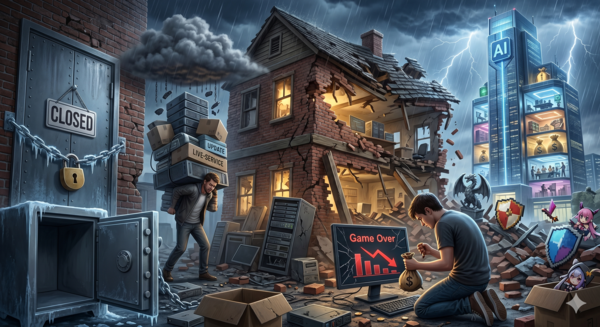
South Korea's small and midsize game developers are flashing repeated signs of crisis. A string of setbacks has followed last year’s halt in updates and bankruptcy of PixelTribe’s “Goddess Order”, including CloverGames’ corporate bankruptcy filing and a publishing dispute between Hound13 and Webzen. Some see a shared backdrop that is hard to dismiss: a fragile survival structure in which early launch failures quickly lead to scaled-back operations, tighter funding and staff departures.
PixelTribe was the first to jolt the market. The mobile RPG “Goddess Order”, released in September last year through Kakao Games, halted all updates within 5 to 6 weeks due to the developer’s funding and management problems. The Suwon Rehabilitation Court declared the company bankrupt in December last year, derailing a project seen as a second-half hopeful. PixelTribe CEO Jung-hyun Bae (배정현) said user numbers and sales fell sharply despite positive indicators right after launch, and that the company reviewed every option, including raising new investment and restructuring, but ultimately could not avoid bankruptcy proceedings.
CloverGames’ collapse followed the same path. Founded in 2017, the company built a user base among subculture players with titles including “Lord of Heroes”, but fell into full capital impairment after its new game “Heaven Hells”, released in February, failed to gain traction. It filed a corporate bankruptcy petition early this month. “Heaven Hells” ranked No. 1 in Google Play downloads early on, but its sales ranking stayed outside the top 140. It drew users but did not convert them into paying customers. CloverGames CEO Sung-kook Yoon (윤성국) said, “Over the past 3 years, I put in more than 3 billion won of my own money and all employees and executives did everything we could, but we hit physical limits and had to make a painful decision.” The company will end all services for games currently in operation on May 9.
Hound13 is also in the same vein in that it exposes the weak business structure of small developers. The publishing conflict with Webzen over the “Dragon Sword” project is on the surface a contractual dispute, but some interpret it as rooted in differences over business sustainability and publishing terms.
Hound13 notified Webzen in February that it was terminating the publishing contract, citing non-payment of the remaining balance of a minimum guarantee (MG). Webzen later paid the remaining amount but maintained that the contract remained valid. After talks broke down, Hound13 shifted to releasing “Dragon Sword: Awakening” on Steam through self-publishing. In the process, its staff fell from about 160 to around 50.
The primary cause running through these cases is an early failure to monetise. For mobile collectible RPGs and subculture games, the first 2 to 4 weeks after launch are typically seen as the peak sales period. If they fail to secure enough revenue in that window, their structure makes it difficult to cover the costs of updates, events and server operations afterward. The case of “Heaven Hells”, which topped downloads but stayed outside the top 140 in sales, clearly shows that gap. Because immersion in characters and story is key in the subculture genre, operators must keep up detailed communication with users across operations, including update direction, event design and community responses. This is also cited as why long-running hits are rare, with a few exceptions such as Nexon’s “Blue Archive” and Shift Up’s “Goddess of Victory: NIKKE”.
When early sales fall short, updates shrink, and fewer updates drive users away. User attrition then leads to further sales declines and failed fund-raising. As retaining staff also becomes difficult, the cycle repeatedly ends in service shutdowns or bankruptcy.
◆Investment cools, costs rise, gap with big developers widens
Beyond individual flops, a worsening macro environment is also weighing on the sector. After the pandemic, the gaming population has declined, and higher interest rates and a concentration of investment in artificial intelligence (AI) have combined to reduce external funding flowing into the game industry. Labour costs that rose during the pandemic have remained as fixed costs even after revenue fell, pressuring the profit structure of smaller developers.
Small developers are also at a disadvantage in the race to improve development efficiency using AI. Large developers with dedicated teams and investment capacity are pushing cost cuts and faster development through AI adoption, while smaller developers find the adoption cost itself burdensome and lack sufficient capability to use it. This structure is gradually widening the productivity gap. With funding inflows shrinking and cost burdens rising, an expanding competitiveness gap with large companies leaves small developers with ever less room to survive.
An industry official said, “The very capacity to hold out when an early launch fails is different from large companies.” The official added, “In situations where investment dries up and labour costs remain, in most cases there are few choices other than restructuring or ending service.”
 Ho-jung Lee
lhj@d-today.co.kr
Ho-jung Lee
lhj@d-today.co.kr