
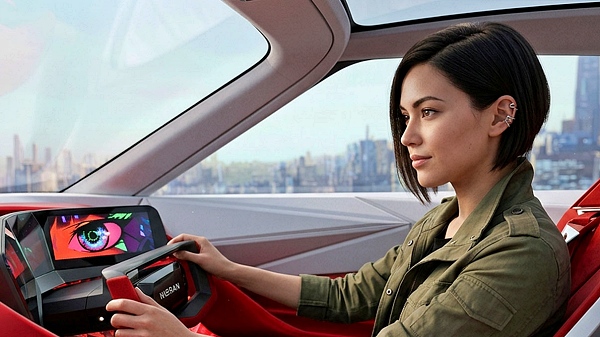
[DigitalToday reporter Jinju Hong (홍진주)] Nissan Motor, a Japanese automaker, announced a vehicle strategy to apply artificial intelligence-based driving technology to about 90 percent of its overall lineup over the long term. It is seen as a transformation strategy combining software, electrification and a revamp of product architecture.
On April 14 local time, Japanese ITmedia reported that Nissan unveiled a long-term vision titled, "With smarter mobility, make every day a new experience." It presented the next-generation vehicle concept "AI Defined Vehicle" as a core pillar, with AI at the centre.
An AI Defined Vehicle combines "AI Drive" technology to advance autonomous-driving performance with "AI Partner" technology to expand user experience while on the move. AI Drive focuses on improving autonomous-driving completeness by applying AI to existing advanced driver assistance systems and vehicle control and safety technologies. AI Partner is responsible for connecting the vehicle naturally with everyday life.
Nissan also laid out an implementation plan. It said it will introduce next-generation ProPILOT in the Elgrand scheduled to be released this summer and aims to implement end-to-end autonomous driving technology by the end of fiscal 2027. The technology is cited as a key element of the AI Drive strategy.
In its electrification strategy, Nissan puts its e-Power electric motor drive system at the centre. It plans to develop its own hybrid technology for body-on-frame vehicles. It will also expand plug-in hybrids and range-extended electric vehicles through partnerships to broaden product choices.
Its product strategy focuses on improving profitability. Nissan will cut the number of models from 56 to 45 and manage them in 4 categories: heartbeat models, core models, growth models and partner models. At the same time, it plans to shift to a structure in which 3 core product groups account for more than 80 percent of total sales.
Its new-vehicle strategy will be rolled out accordingly. The new X-Trail and Rogue with e-Power were presented as global core models, and the Juke EV was unveiled as a core model targeting the European market. The U.S.-market Xterra and Japan-market Skyline were shown in teaser form.
Nissan also clarified its region-by-region market strategy. It set Japan, the United States and China as core markets, and in particular presented targets of 550,000 vehicle sales in Japan in fiscal 2030 and 1,000,000 vehicle sales each in the United States and China.
Nissan also mentioned progress on its management turnaround plan, Re:Nissan. It said improvements to its cost structure and adjustments to production capacity are proceeding as planned, and it will disclose detailed progress in its May earnings announcement. It will also announce additional strategies in the second half of this year.
The announcement is drawing attention for bundling AI-based software, electrification and product restructuring into a single axis. A key point to watch is how specific the actual scope of applying AI driving technology and region-by-region product strategies will become.
 Jinju Hong
hongjj@d-today.co.kr
Jinju Hong
hongjj@d-today.co.kr