
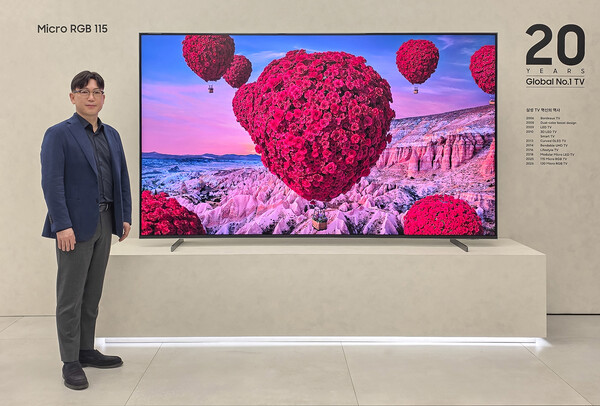
Samsung Electronics is adding an AI platform and voice-based search and control features across its entire 2026 TV lineup. It is moving to redefine TVs from devices that users flip channels with a remote into screens that respond when spoken to and understand context.
Samsung Electronics held a new product launch event, “The First Look Seoul 2026”, on Tuesday and unveiled a wide range of TVs and related set products. It showcased TV lineups including Micro RGB, OLED, Neo QLED, mini LED and UHD, along with the lifestyle TV “The Frame”, the portable screen “Moving Style”, the Wi-Fi speaker “Music Studio” and the all-in-one soundbar “Q Series”. A common principle for this year’s lineup is to provide the same AI functions regardless of price range, from premium to entry-level.
What the products have in common is a plan to become a “companion” like a smartphone. Just as smartphones became devices that search by touch and voice and move across apps, Samsung Electronics showed an intent to bring the same user experience to TVs.
At the center is the integrated AI platform “Vision AI Companion”. While watching a movie, if a user asks, “Where is this filming location?”, the AI analyses the scene on the screen and immediately displays related information. It replaces the process of opening a search box and typing keywords on a smartphone with a single voice command on a TV.
It also loaded the industry’s largest number of AI services at the same time, including Bixby, Perplexity and Microsoft Copilot, in the same context. Just as users choose search engines or AI assistants on a smartphone based on preference, it kept options open so users can use familiar AI services on TVs as well.
Behind that, it embedded AI. The system works even in areas where users do not directly issue commands. “AI Soccer Mode Pro” analyses match scenes in real time to adjust colour and precisely depict even subtle ball movements, and reproduces stadium realism including crowd cheers and commentary sound. “AI Sound Control Pro” separates dialogue, background music and sound effects in real time for automatic optimisation, and also allows selective adjustments such as turning up only the commentator’s voice or lowering crowd noise. Along with “AI Upscaling Pro”, which upgrades low-resolution video to high quality, the same kind of AI-based image correction used by smartphones for night shooting is applied across TV viewing.
◆ TVs, like smartphones, enter an era of “choices by inch”
Samsung TVs also significantly expanded physical screen choices. It mirrors the smartphone market, which has segmented lineups by use from standard models in the 6-inch range to foldable large screens.
This year it expanded the Micro RGB lineup to 65-, 75-, 85- and 100-inch models. After the first launch of a 115-inch model last year, it added a 130-inch model and has now widened the range to small and mid-size screens. It also newly unveiled an entry-level “mini LED” TV while applying the same AI functions, keeping its principle of offering the same AI experience regardless of price. In the top-tier “RH95” model, which independently controls colours with RGB LEDs smaller than 100 micrometres, an AI processor analyses colour tones by scene in real time.
Its form-factor diversification strategy is similar. Just as smartphones expanded in shape from bar types to foldable and flip models, Samsung TVs are changing viewing itself with wall-mounted, frame-style and portable designs. “The Frame” added a 98-inch large screen and applied a slim-fit design that sits 0.9 mm flush to the wall, while the OLED “SH95” adopted a “Float Layer” design reminiscent of a frame. The portable screen “Moving Style” expanded to 85 inches, allowing use in any space without fixed installation. The “Glare free” technology that reduces light reflection was also expanded across all models of Micro RGB, Neo QLED 8K, Samsung OLED and The Frame.
TV sound is also evolving in a direction that reduces reliance on external equipment. The Wi-Fi speaker “Music Studio 7” delivers 3D immersive sound with a single 3.1.1-channel unit and plays high-quality 24-bit, 96 kHz audio sources with a 35 kHz super tweeter.
It also expanded the content ecosystem. It is moving beyond the limits of existing TVs, which could be enjoyed only when supplied with content, toward increasing consumers’ ability to search and choose. Just as smartphones expanded a device’s value through app stores, TVs are widening the uses of the screen as a content platform.
For example, Samsung TV Plus provides major performances each month, including the musicals “Hero” and “Crash Landing on You”, as well as SM artists’ concerts. It also plans to introduce content for next-generation 3D audio “ECLIPSA AUDIO”, jointly developed with Google, and a “Multi Cam” function that allows multi-angle viewing.
Yong Seok-woo (용석우), head of Samsung Electronics’ Visual Display Business, said, “Based on more perfected AI functions and technological capabilities, we presented the standard for AI TVs.” He said, “We will go beyond a simple display to provide a screen experience as an ‘AI everyday companion’ that understands and stays with users’ daily lives.”
 Suk Dae-geon
d2dg@d-today.co.kr
Suk Dae-geon
d2dg@d-today.co.kr