
As artificial intelligence spreads and rapidly reshapes the software industry, criticism is growing that domestic rules and ordering structures remain stuck in the system integration era. Public and financial-sector network separation, labour-input pricing and service-centred public procurement practices are being blamed for blocking the shift to AI.
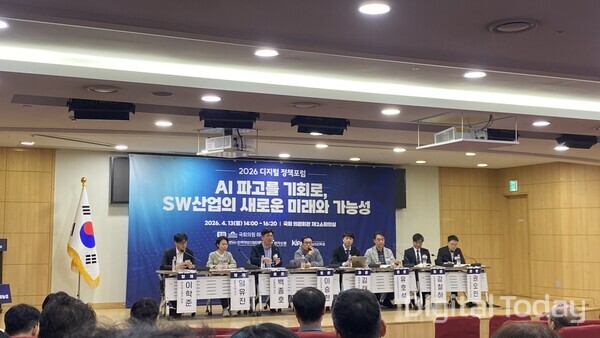
At the 2026 Digital Policy Forum held at the National Assembly Members' Office Building on April 13, industry, academic and policy experts agreed that reforms are urgently needed to remove obstacles to embedding AI.
Rep. Lee Hae-min (이해민) of the Rebuilding Korea Party, a member of the National Assembly Science, ICT, Broadcasting and Communications Committee, said in congratulatory remarks, "We talk about being a top-3 AI powerhouse, but in many cases the foundation fields that make up AI do not receive budgets because they do not include the word 'AI'." She added, "The software industry must grow together."
Lee Hak-jun (이학준), chief executive of Madras Check, said network separation rules are a major hurdle. He said AI writes 90 of every 100 lines of code in the field, but pointed to conditions in which public and financial institutions cannot connect and use external services such as Claude or OpenAI.
He said that was like sending employees out with sickles in an era when tractors have been introduced, and called for a shift from physical isolation to encryption- and monitoring-based logical security, like the U.S. zero trust policy.
He also pointed to changes in cost structures. He said some IT company heads now describe labour costs as wages plus token costs, and stressed the need for policies to support token costs so software companies can connect and use various large language models. On public procurement, he criticised what he called a contradictory structure in which companies cannot register for procurement without a track record, but must be listed in procurement to build one.
The discussion that followed also produced a string of comments that the current system is failing to keep up with the speed of the AI shift. Lee Seung-hyun (이승현), vice president at 42Maru, said there is no hope for the domestic software industry unless the structural problem is solved of having to separately build a public G-Cloud, a financial version and a private-sector version. He said AI changes every two weeks, but original plans become fixed while going through information strategy planning, preliminary feasibility studies and request-for-proposal procedures, and said the country will not be able to keep up unless a fast track is opened.
Calls to overhaul the pricing system also emerged as a key issue. Public software projects currently rely on a man-month system that sets unit prices based on the number of staff deployed and their experience. As AI boosts development productivity, the basis for calculating labour costs collapses, leaving companies with no improvement in profit structure even if they adopt AI, critics said.
Kang Cheol-ha (강철하), head of the Future Convergence Policy Research Institute, proposed switching to a value-based pricing system for software companies integrated with AI, reflecting computing and infrastructure costs in unit prices. Yoo Ho-seok (유호석), a researcher at the Software Policy and Research Institute, said the current billing structure is based on headcount and cost-plus margins, which leads to SI being treated as outdated. He said SI capabilities are instead an asset in an era of domain and AI convergence.
The government also partly acknowledged the need to overhaul the system. Kwon Oh-min (권오민), director of the Software Industry Division at the Ministry of Science and ICT, said it is a settled fact that the rise of AI agents has caused a major upheaval in the software industry. He said token costs can be addressed through vouchers and tax credits, and security through a shift in the regulatory framework. He also cited reviews of the pricing system for public software projects, improvements to closed environments and an overhaul of budget systems as tasks under consideration.
 Seulgi Son
sageson@d-today.co.kr
Seulgi Son
sageson@d-today.co.kr