
[Digital Today reporter Jinju Hong] E-bike motors split clearly by inner-rotor and outer-rotor designs, with distinct differences in noise, efficiency, cost and applications.
On April 10 local time, mobility outlet BikeBiz cited comparison data from Chinese e-bike drive-system manufacturer Bafang and said motor architecture is a key variable that determines riding experience and performance.
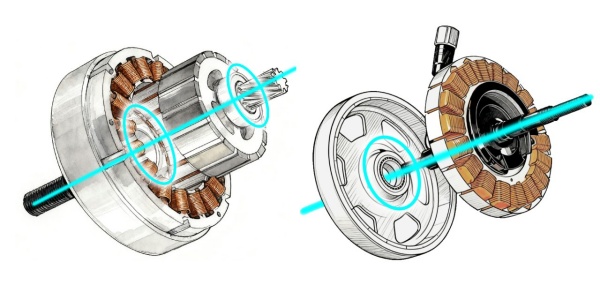
Bafang described the battery and motor as core components of an e-bike, and said differences in motor structure are a key factor shaping product characteristics. In an inner-rotor motor, the rotor spins inside while the stator is positioned outside. In an outer-rotor motor, the rotor turns on the outside and the stator sits at the centre. The analysis said these design differences directly affect overall characteristics such as efficiency, noise and manufacturing costs.
In terms of noise and vibration, the inner-rotor design showed strengths. Bafang said the inner-rotor bridge structure reduces speed and torque fluctuations to deliver a smoother and quieter ride. The outer-rotor design, it said, can produce relatively more noise because its cantilever structure tends to allow greater fluctuation.
On cost and structural complexity, the outer-rotor design has the advantage. Inner-rotor motors have more complex structures, raising manufacturing costs and maintenance burdens, while outer-rotor motors have simpler designs that improve cost efficiency and ease of servicing. As a result, inner-rotor motors were presented as suitable for models where noise suppression and efficiency matter, while outer-rotor motors fit products where price competitiveness and simplicity are important.
Performance characteristics also differ. Inner-rotor motors can use high reduction ratios and have higher transmission efficiency and power density, making them advantageous for high-speed riding. Outer-rotor motors suit lower reduction ratios and allow more compact structures, but they tend to use more power and have lower high-speed efficiency.
Bafang did not emphasise any absolute superiority of one structure. The company said choosing between inner-rotor and outer-rotor designs depends on the situation, and that selecting a structure that matches usage purpose and product design direction is best.
It also stressed that e-bike performance is not determined by the motor alone. Integration of the controller, battery, display and overall design is equally important, it said, and overall system completeness determines the actual riding experience.
Bafang emphasised user-centred design as a future direction for research and development. As the e-bike market becomes more intelligent and increasingly focused on efficiency, it said competition in integrated technologies that reflect customised rider demand will become more important.
In the industry, some say the comparison went beyond a simple technical explanation by structurally organising criteria for selecting e-bike drive systems. Manufacturers' design strategies are expected to differentiate depending on how they apply the strengths and weaknesses of each motor structure across product categories.
 Jinju Hong
hongjj@d-today.co.kr
Jinju Hong
hongjj@d-today.co.kr