
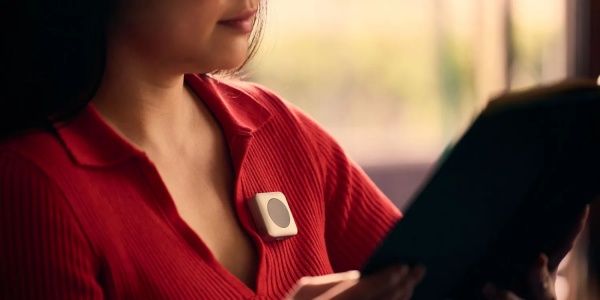
[DigitalToday reporter Jinju Hong] Former Apple engineers have unveiled a small artificial intelligence (AI) wearable device called "Button" that resembles the iPod Shuffle, but questions are being raised about the need for it as a dedicated device.
The product was developed by Chris Nolet (크리스 노렛) and Ryan Burgoyne (라이언 버그와인), IT media outlet 9to5Mac reported on April 9 local time. Based on their experience working on the Apple Vision Pro, the pair introduced a standalone device that calls up AI functions by pressing a physical button.
Button, unlike always-on AI devices, is designed to operate only when the user presses the button. Compared with existing AI wearables that continuously collect surrounding sounds, this approach is differentiated in that it can reduce concerns about privacy infringement.
Still, market attention is focused less on features than on why it has to be a separate device. Critics say sufficient reasons have not been presented for launching it as dedicated hardware even though the same functions could be implemented as a smartphone app. With most users already carrying smartphones at all times, they say it is unclear why another device needs to be carried.
This skepticism also intersects with weak performance in the existing AI wearable market. Humane AI Pin and Rabbit R1, among others, received assessments that fell short of expectations after launch, leaving questions about the need for dedicated AI devices itself. In particular, prominent U.S. consumer electronics review YouTuber Marques Brownlee (마르케스 브라운리) even described the AI Pin as the "worst product".
Button offers a partial solution to privacy issues by adopting user-initiated activation instead of always-on listening. But assessments say it still lacks persuasive force on its reason for existing as a separate device, meaning usability distinct from smartphones.
Ultimately, Button again exposes two challenges facing AI wearables: personal data protection and the need for dedicated hardware. It offered some answers to the first issue, but the second remains unresolved. For AI-specific devices to establish themselves as a new device category after smartphones, they will likely need to prove first why usability must be separated, not merely differentiated by form.
 Jinju Hong
hongjj@d-today.co.kr
Jinju Hong
hongjj@d-today.co.kr