
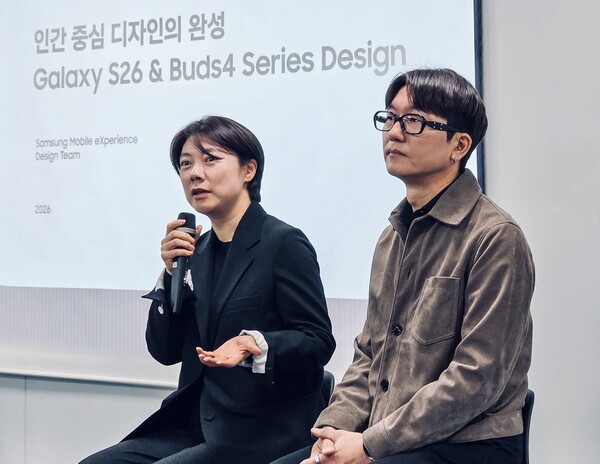
Samsung Electronics unveiled its Galaxy design philosophy. It emphasised a “people-centred design” direction that blends naturally into users’ daily lives rather than strongly highlighting advanced technology. Samsung Electronics held a media briefing on April 9 and introduced the design concept and development process for the Galaxy S26 series and Buds4 series released last month.
The briefing showed how the principles were implemented in actual products. Lee Il-hwan (이일환), head of the design team at the MX Business, introduced a new Galaxy design direction as “a design that puts emotion into a modern form.”
Lee said Galaxy products contain advanced technology but the new direction is to pursue a design that accompanies consumers’ daily lives by adding a comfortable and soft sensibility. He said it made Galaxy’s premium identity clearer by adding soft and comfortable emotion to modern forms, including colour, materials and texture.
The most noticeable change is the Galaxy S26 Ultra. Up to the S25 Ultra, Samsung applied a different corner curvature from the standard models, but the S26 Ultra adopts the same curvature as the S26 and S26 Plus. The S26 series became the first S series to unify the outer silhouette across three models.
Lee Ji-young (이지영), an executive director on the MX Business design team, said it derived 7R as the optimal corner curvature after considering a Galaxy-like impression, a comfortable grip and balance in the overall form. She said it completed the 7R by matching the curvature asymmetrically not only on the corners but also on the S Pen tip.
She also shared behind-the-scenes details from the design process. The product became thinner and lighter, but a visual step between the body and the camera, created by adding a high-performance camera, was a challenge. To address it, Samsung applied a camera island that slightly protrudes around the camera, while using a material that integrates with the back so it does not stand out excessively. Lee said it aimed to pack in technology strongly while making the impression users receive more natural.
◆ Fit is performance... redesign based on experiential data
Mauro Porcini (마우로 포르치니), Samsung Electronics’ design leader, had foreshadowed this direction at the Samsung Tech Forum held during CES 2026 earlier this year. Porcini said a people-centred approach is an obvious responsibility for the future and is essential strategically and economically beyond mere justification. He said Samsung Electronics applies the principle “Form and function follow meaning” across its design.
Buds4 also stems from the same philosophy. Song Jun-yong (송준용), a group head on the MX Business design team, said in wearables, fit is not only about comfort but also about performance. He said Buds4 prioritised fit the most because it is a product where the high-quality sound experience is important.
Samsung Electronics designed the fit based on more than 100 million ear-shape data points collected worldwide and more than 10,000 wear simulations, secured through collaboration with the University of Michigan since 2024. It said it focused on finding a balance between comfort and stability by analysing pressure on the ear, holding force and stability while moving.
Based on those criteria, it completed a vertical form that considers the angle touching the ear and where it is held in the hand. It also changed the charging case from a vertical type to a horizontal type so the grip direction for picking up the buds is maintained until they settle in the ear. The shift Porcini described as moving from product-centred design to designing the experience was also applied to Buds4. Song said it is a product redesigned with technology and data to provide optimal fit for the greatest number of users.
 Suk Dae-geon
d2dg@d-today.co.kr
Suk Dae-geon
d2dg@d-today.co.kr