
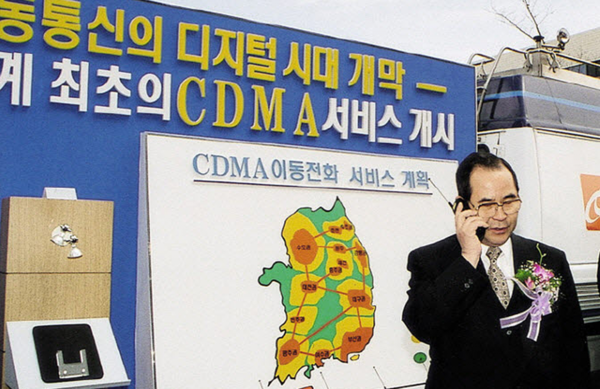
SK Telecom is stepping up efforts to spread new communications technology beyond the 30th anniversary of code division multiple access (CDMA) commercialisation. It is accelerating construction of an artificial intelligence (AI) highway and will commercialise 5G standalone mode (SA) within the year.
KT held a media study session on April 7 and introduced the development of mobile communications technology including CDMA. CDMA is a core 2G technology that distinguishes a single frequency band with unique codes, allowing multiple users to use it simultaneously without interfering with each other.
Demand for CDMA grew due to the limitations of analog-based 1G. The existing analog method had limits in accommodating a rising number of subscribers. As call quality deteriorated, the need for a shift to digital emerged.
At the time, time division multiple access (TDMA) was effectively the 2G standard, but South Korea chose CDMA, which had higher capacity and technological self-reliance than TDMA. On April 12, 1996, Korea Mobile Telecom, the predecessor of SKT, began commercial CDMA service in Seoul and the surrounding metropolitan area. South Korea became the first country to commercialise digital mobile communications through this.
The spread of CDMA led a revival in the mobile communications market. The number of mobile subscribers in South Korea, in line with CDMA adoption, surpassed 10,000,000 in 1998 and overtook landline telephones in 1999. The information and communications industry's share of value added in GDP expanded to 13.1 percent in 2025 from 2.2 percent in 1996. In size, it increased to 304 trillion won from 17.8 trillion won.
Lee Nae-chan (이내찬), a professor of economics at Hansung University, said in a study presentation, "The world's first commercialisation of CDMA became the starting point for South Korea's ICT leap." He added, "Even during the IMF crisis, only the mobile communications market grew."
According to a survey by polling platform TilianPro, conducted over two days on April 2 and 3 of 1,500 adult men and women nationwide, 786 said they knew about South Korea's CDMA commercialisation when asked whether they were aware of it. Of them, 79.5 percent said it played an important role in the development of South Korea's information and communications industry.
The communications market has moved past the CDMA era to 3G in the 2000s and 4G in the 2010s, and entered the 5G era in 2019. SKT laid the foundation for its shift into an "AI company" by commercialising 5G service for the first time in the world in April 2019. It launched the "A." service in 2022 and is strengthening full-stack AI competitiveness spanning AI data centres, models and services. SKT explained that just as it built a "communications highway" connecting the nation with CDMA 30 years ago, now is the time to build an "AI highway" that carries data and AI.
Lee Jong-hoon (이종훈), head of network strategy at SKT, said, "In the AI era, networks are evolving into 'intelligent infrastructure' that learns and processes data." He added, "This will become the foundation that determines productivity and the speed of innovation across all industries, including manufacturing, logistics, healthcare and finance."
SKT is also accelerating the build-out of new communications infrastructure. It plans to complete the introduction of 5G SA no later than within the year. Unlike the existing non-standalone (NSA) approach, 5G SA uses a dedicated core without relying on a 4G LTE core network. It has strengths in ultra-low latency, network slicing and high-speed data transmission, allowing it to process more traffic efficiently.
Lee said SKT is currently conducting demonstrations with the aim of commercialising 5G SA within the year. He added that actual commercial service would be possible in the fourth quarter.
 Jin-ho Lee
jhlee26@d-today.co.kr
Jin-ho Lee
jhlee26@d-today.co.kr