
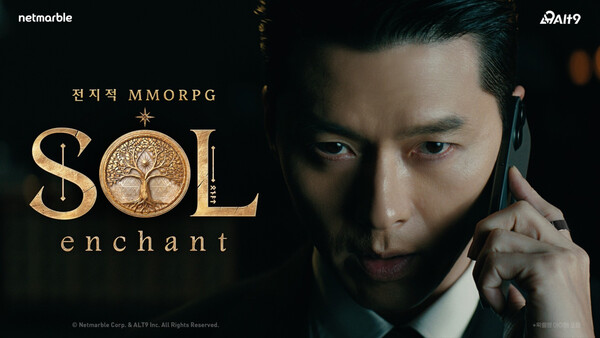
Netmarble's new massively multiplayer online role-playing game (MMORPG) "Sol: Enchant", which begins service on April 24, has touched a market taboo even before launch. Within 1 minute of starting an online showcase in March, the developers directly acknowledged the game belongs to the genre users commonly call "Lineage-like". They made no attempt to hide that it includes gacha, a marketplace, collections and auto-hunting. They also confidently mentioned the possibility of cash-like trading between users, known as "ssal-meok". By putting elements typically concealed or softened in the MMORPG market front and center, attention is on how this may affect the game's future performance.
Netmarble's approach is intertwined with the reality of the competitive MMORPG market. With fatigue in the genre rising, it has become harder to attract attention simply by repackaging familiar formulas. An analysis says Sol: Enchant attempts differentiation by openly revealing the genre's core desires and adding a new device called user authority on top of them. At the showcase, Kim Hyo-su (김효수), a development PD at new studio Alt9 led by key developers of "LineageM", said he put into action the idea of "if customers participate directly in planning".
◆Operational authority raised as a reward... structure of the divine authority system
The key is the "divine authority" system. "Sol: Enchant" introduced a three-tier authority structure of god, demi-god and absolute god. A server-level god can exercise powers such as summoning monsters, dropping meteors on certain areas, setting safe zones and banning certain users from chat.
A world-level demi-god can also intervene in areas typically handled by a developer's balance planner, such as opening closed content and adjusting reward values. The top-tier absolute god exists as only 1 person across all servers. That role decides updates and business model (BM) choices, server integration and settings resets. The explanation is that if the absolute god does not want an update, even the developer would find it difficult in practice to push it through. The role is also granted the authority to take accumulated taxes on the server and to directly create desired items.
The core criterion for becoming a god is the amount of in-game currency called "Nain" used. Demi-gods and the absolute god are decided through competition among gods on each server, and a "contribution" system also runs in parallel, allowing users to transfer Nain to others to help a specific user ascend to godhood.
This structure is drawing attention because it turns operational authority itself into the game's reward system. While existing MMORPGs designed power around equipment, combat power and castle occupation, Sol: Enchant also raises operational authority as a reward. Netmarble's decision, ahead of launch, to set the server opening time and the first update class by user vote is in the same context. The vote result set the server to open at noon, and the first new class was chosen as a healer.
◆The money-making structure is clear... the question is what comes next
The issue is that a structure that makes money well is not the same as a structure that runs well. The BM design also clearly shows the game's direction. In Sol: Enchant, major paid items such as god armor, spirit bodies and accessories, purchased with diamonds (paid currency), are included as trade targets. Items can be extracted and listed on the marketplace in the form of summon tickets, and the system is designed so paid items can also be bought with Nain, an in-game currency.
Nain is the key currency obtained across gameplay, including killing monsters, dungeons, dismantling equipment and even failed enchants. The game also introduced a structure in which users convert character experience into Nain cores and distribute them through the marketplace. Through an "open purchase" function in which the system directly buys bound items with diamonds, even users who do not pay or pay small amounts can secure paid currency through play alone.
The developers said they will not sell Nain directly in the shop and said they will not sell high-priced experience products known as "deu-sang" (items that increase item drop rates and experience gains). They added they plan to separately operate limited experience potions that slightly help growth so they can be purchased only with in-game Nain. They will also provide 24-hour offline play and squad mode, which raises up to 3 characters simultaneously, for free without a separate pass.
The logic for success is clear. For users who pay little or nothing, it offers the rationale that they can earn currency by spending time. For paying users, it provides the motivation that the money they spend becomes a tradable asset. That is the same context in which Kim Jang-hwan (김장환), head of Netmarble's business division, answered "I'm confident" when asked whether "ssal-meok" is possible.
Still, expanding freedom in MMORPGs tends to lead to higher control costs. That is because it introduced sensitive elements all at once, including unlimited offline play, raising 3 characters simultaneously, tradable paid items, converting experience into economic value, and tax rates and operational influence through divine authority. Even taken individually, each could raise concerns over economic distortion and the spread of farming operations. The developers presented countermeasures including an AI detection system, doubling monitoring staff compared with existing levels, and a structural limitation that causes growth stagnation when Nain is mass-produced.
The stronger divine authority becomes, the more problems can arise with power concentration and long-term rule. The higher the freedom to trade, the greater the possibility that some forces will take control of the economy. Whether this structure will actually lead to a healthy balance of power, or converge into competition among certain highly organised forces, is something that can only be judged after launch.
As for initial interest, signals showing potential success have been confirmed. In-game footage released before launch and an advertising video featuring actor Hyun Bin recorded 5.5 million and 3.2 million views, respectively, in less than a week after release.
Netmarble has also previously delivered consecutive successes in the MMORPG genre, including last year's "RF Online Next" and "Vampir". Still, the real test for this game is likely to hinge not on revenue on launch day but on how it responds when the first power clashes, economic distortions and operational controversies erupt.
An industry official said, "The divine authority system is an experimental attempt in that it hands decision-making power, which developers have monopolised, over to users." The official added, "Once users have operational authority, responsibility for the results also becomes unclear, so how Netmarble organises this part will be a key variable for long-term service."
 Lee Ho-jung
lhj@d-today.co.kr
Lee Ho-jung
lhj@d-today.co.kr