
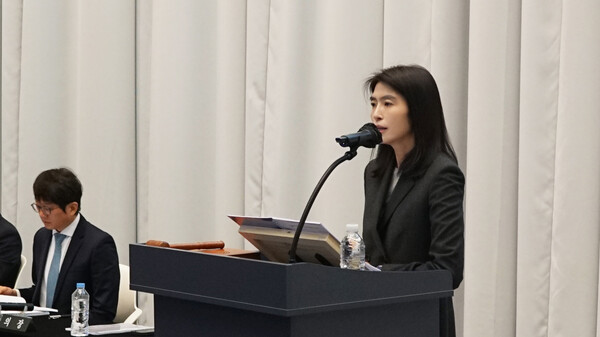
Kakao, now in the second term under Jeong Shin-a (정신아), is stepping up its shift to artificial intelligence. While the first term focused on streamlining an overextended affiliate structure and governance, the second term must show a full recovery in growth. A key variable is expected to be proof of profitability centred on KakaoTalk and AI.
Kakao passed a proposal at its 31st annual general meeting of shareholders on March 26 to reappoint Jeong as an inside director. The term runs through March 2028. Over two years in the first term, Jeong cut the number of affiliates from 132 before taking office to 94 as of the end of last year, and raised operating profit to 732.0 billion won from 460.2 billion won. Revenue also rose to 8.1 trillion won, surpassing 8 trillion won for the first time since the company’s founding.
Jeong said, "This year will be a year of shifting our strategic stance to restore a growth rate befitting a growth stock."
◆ Shifting gears after two years... Building a base through selection and concentration
With the launch of the second term, Kakao revamped the title system of the CA Council. Previously, Jeong, as chair, and committee leaders all used the title "president". After criticism that this caused title inflation and delayed decision-making, it changed leaders’ titles across the board to "head". The CA Council was also reorganised into three offices and four divisions to slim down the organisation.
It is also speeding up the move to streamline affiliates. If the sale of Kakao Games shares is completed in May, CA Council affiliates will be reorganised into five companies including Kakao, Kakao Bank, Kakao Mobility, Kakao Pay and Kakao Entertainment, and the total number of affiliates is expected to fall to 88. The transfer of Upstage’s stake in AXZ, the operator of Daum, is also under way. Jeong Ho-yoon (정호윤), an analyst at Korea Investment & Securities, said strategy is shifting away from diversified business expansion in the mobile era toward increasing time spent on the platform with AI and diversifying revenue models.
◆ KakaoTalk as an execution platform... AI and global expansion as two pillars
A core element of the second-term strategy is redefining KakaoTalk as an AI-based execution platform. The concept Jeong has put forward is "agentic AI". It is a structure that connects the full process of execution inside KakaoTalk, from identifying a user’s intent to search, booking, payment and mobility. Kakao is working to bring external services into the platform through "PlayMCP" and an "AI agent builder".
External partnerships are also taking concrete shape quickly. Musinsa, Olive Young and Hyundai Department Store have been added as partners for "ChatGPT for Kakao", while Airbnb has been linked to "Kanana in KakaoTalk". "Kanana Lab", set to be introduced in the first half of the year, is a space where users can try new AI features before official releases and provide feedback, a measure to restore user trust after last year’s controversy over changes to the Friends tab.
Expanding time spent by users can be interpreted as a signal of a shift in the revenue structure beyond a simple usage indicator. The structure suggests that as time spent increases, the frequency of linking with external services also rises. This points to the possibility of expanding from an advertising-centred structure to transaction- and linkage-based revenue sources. That is why Kakao has set a key target indicator of increasing average daily time spent on KakaoTalk by more than 20 percent.
Global expansion is also being pursued as a secondary pillar of the second term. The goal is to build a "global fandom ecosystem" that combines AI technology, content intellectual property and payment infrastructure. Kakao Entertainment’s Piccoma posted record results last year, achieving annual operating profit of 94.5 billion won, and global fan platform Berriz reached an 80 percent share of overseas users within a year of launch.
On the performance front, Kakao presented targets of more than 10 percent growth in consolidated revenue this year and an operating profit margin of 10 percent. Securities firms expect first-quarter results to meet or slightly exceed the consensus. Korea Investment & Securities forecast operating profit of 188.5 billion won, above the consensus, while Hanwha Investment & Securities and DB Financial Investment estimated 172.8 billion won and 171.7 billion won, respectively. For shareholder returns, it plans to increase the total dividend payout by 10 percent from a year earlier and cancel more than half of its treasury shares.
◆ Direction is clear... The market still sees an 'unfinished equation'
However, the market reaction is cool. Kakao shares closed at 46,400 won on April 7, down about 35.2 percent from the peak of 71,600 won in June last year. Korea Investment & Securities and DB Financial Investment lowered their target prices to 70,000 won and 69,000 won, respectively. Only Hanwha Investment & Securities maintained 85,000 won.
Market doubts are focused on when and how AI monetisation will be reflected in results. The prevailing view is that the AI business is closer to an auxiliary tool to increase time spent on existing platforms and improve advertising efficiency, and securities firms see a full contribution from AI-related revenue coming after 2027. Concerns remain that increases in revenue-linked fees, outsourcing and infrastructure costs this year could limit the scale of profit growth. There is also still a view that Kakao’s own AI model, "Kanana", is centred on lightweight models, meaning its starting point differs from global big tech’s hyperscale models.
Still, positive views coexist. Jeong Ho-yoon said, "If usability increases through linkage with external services, it will take time, but the likelihood of leading to monetisation is high."
Kim So-hye (김소혜), an analyst at Hanwha Investment & Securities, also forecast, "The lower share price is a section where upside factors are reflected more than concerns," adding, "If even part of the possibility of monetising AI agents is confirmed, a gradual re-rating will appear."
Jeong reiterated an AI-centred growth stance at this shareholders meeting. But a dual challenge remains: narrowing the AI capability gap with global big tech while restoring market trust at the same time. Whether Jeong’s second term can become the first year of a substantive shift into an AI company will depend on the moment it is proven with numbers, not declarations.
 Lee Ho-jung
lhj@d-today.co.kr
Lee Ho-jung
lhj@d-today.co.kr