
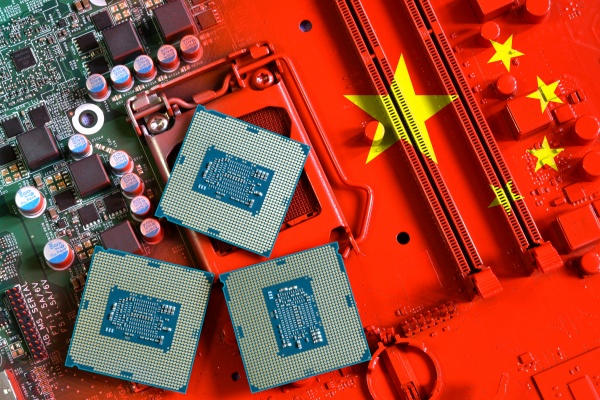
The U.S. Congress has introduced new export-control legislation to block sales of semiconductor equipment to major Chinese chip companies, as well as maintenance and technical support, Cryptopolitan, a blockchain media outlet, reported on April 3 local time.
Republican and Democratic lawmakers introduced the MATCH Act and said it would sharply narrow access to key equipment that China cannot produce on its own.
The bill aims to block Chinese companies from procuring equipment to preserve U.S. advantage in the artificial intelligence race. Unlike existing China-related restrictions that have been pushed mainly by the White House under the Trump and Biden administrations, Congress has stepped to the fore this time. Sponsors include Representative Michael Baumgartner and Representative John Moolenaar, chair of the House Select Committee on China.
The bill squarely targets ASML's immersion DUV lithography tools. China has mainly sourced the equipment from ASML, with some supplied by Japan's Nikon. The United States already blocks exports to China of ASML's most advanced EUV tools. The MATCH bill goes further by restricting sales of older DUV tools and their maintenance.
It also specified companies subject to the controls. They include SMIC, Hua Hong, Huawei, CXMT, YMTC and related companies. If passed, they would face restrictions on exports, services and technical support in the same way as companies on the U.S. Entity List.
The bill also demanded controls at the same level from allied countries. If allies fail to prove within 150 days that they have tightened their own regulations, the U.S. Department of Commerce would directly implement restrictive measures. It also expanded U.S. control authority over foreign-made products that include U.S. software, technology or parts.
If implemented, the move would inevitably hit ASML. China was ASML's biggest market in 2025, accounting for 33 percent of its total revenue. That share is expected to fall to around 20 percent this year.
The Dutch government offered a cautious response. A Dutch foreign ministry spokesperson said, "It is not our role to comment on draft legislation in another country," and it was reported that ASML did not issue a separate statement.
Meanwhile, possible controls on rare earths were cited as a potential Chinese response. Industry news with a state-run character said a Chinese delegation recently visited research facilities and manufacturers and stressed cooperation in mining, production and commercial use. Western technology companies' concerns go beyond securing raw materials, and are linked to China's advantage in rare-earth refining and processing and in manufacturing products that use them.
 Jinju Hong
hongjj@d-today.co.kr
Jinju Hong
hongjj@d-today.co.kr