
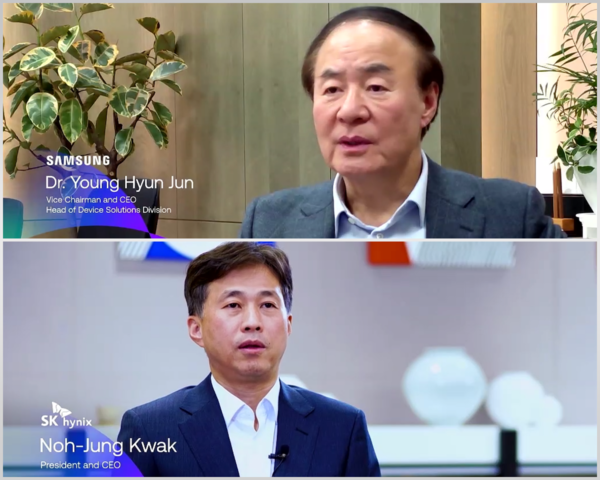
Samsung Electronics and SK Hynix are expected to deliver first-quarter results that beat market expectations this year. The two companies are also pulling their next growth levers in different ways. They are seeking to change their business structures on the back of a memory supercycle.
Mirae Asset Securities estimates Samsung’s first-quarter operating profit at 41.3 trillion won, up 105.9 percent from the previous quarter. Kiwoom Securities forecasts 43.0 trillion won, up 115 percent, and IM Securities sees 45.3 trillion won, up 126 percent. The figures are up to about 15 percent above the market consensus. For SK Hynix, Hana Securities estimates operating profit at 36.9 trillion won, up 92 percent, and IM Securities estimates 39.4 trillion won, up 105 percent. DRAM average selling prices rose 62 to 71 percent from the previous quarter and NAND average selling prices jumped 53 to 80 percent, seen as key drivers of the earnings surprise.
Samsung fired a starting gun for a business overhaul beyond memory in the first quarter. At Nvidia GTC 2026, it was officially confirmed that mass production of Groq LPUs will be carried out at Samsung’s 4-nanometre foundry. The shipment is scheduled for the third quarter, marking a second big tech customer after an order last year for an AI accelerator for Tesla. Mirae Asset Securities analysed that the foundry business is currently posting an operating loss in the 1 trillion won range, but visibility for a turn to profit in the second half is rising as new customers and product orders expand.
Its HBM4 competitiveness also took clearer shape. Samsung said at ISSCC 2026 it implemented an HBM4 speed of up to 13 gigabits per second per pin. It applied a 4-nanometre FinFET-based logic die, seen as a case in which synergy between memory and foundry is coming into full swing.
It also demonstrated a 4F2 structure with HCB-based wafer-to-wafer bonding, strengthening its position as a full-stack manufacturer that also covers advanced packaging. Kiwoom Securities said it will be an opportunity for Samsung, which has secured a technological edge in HBM4, to expand its share of the HBM market.
Memory price surge: Samsung and Hynix prepare for different futures
SK Hynix chose a path focused on laying the groundwork for a valuation rerating. Last month, SK Hynix confidentially submitted an application to the U.S. SEC for an ADR listing. Hana Securities analysed it as a strategy to have its corporate value reassessed in U.S. stock markets, where global big tech companies are listed.
It is also in talks on long-term supply contracts with customers. Unlike in the past, conditions to strengthen binding force, such as upfront payments and penalties, are understood to be being mentioned. Hana Securities said it expects long-term supply contracts with binding force to support a higher valuation multiple by reducing volatility in the memory industry.
In the memory supercycle, Samsung is preparing for the next momentum with a full-stack structure linking foundry and HBM4, while SK Hynix is doing so by pursuing an ADR listing and strengthening the binding force of long-term contracts. After the second quarter, memory price negotiations and whether foundry orders expand are expected to be a watershed that will determine the pace of the two companies’ structural transition.
 Daegeon Seok
d2dg@d-today.co.kr
Daegeon Seok
d2dg@d-today.co.kr