
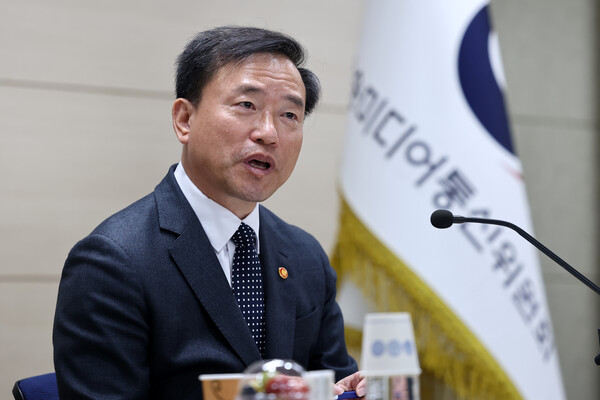
The Broadcast Media and Communications Commission has moved to the brink of holding a plenary meeting after shifting to a six-member lineup. The commission had been effectively paralyzed under a two-member structure, but has secured the quorum needed to pass resolutions and entered a phase of normalization. Still, analysts say political pressure surrounding contentious agenda items remains a variable.
The commission had been run by Chairman Kim Jong-cheol (김종철) and standing member Ryu Shin-hwan (류신환). It recently filled six of its seven seats after appointing and commissioning 1 standing member and 1 non-standing member recommended by the Democratic Party, and 2 non-standing members recommended by the People Power Party.
The change means it now meets the voting requirements needed to convene a plenary meeting. The commission can pass agenda items with at least 4 members present and the approval of a majority of those attending. With the current lineup comprising 4 members recommended by the president and ruling party and 2 recommended by the opposition, the president and ruling party side can process agenda items on its own.
Some assessments say that structure instead adds to the political burden. Follow-up measures to the so-called three broadcasting laws are a representative issue on which the ruling and opposition parties differ sharply. The core of the three broadcasting laws is expanding the authority to recommend directors of public broadcasters from the political sphere to external groups such as academia and civic organizations. The ruling party argues for strengthening the independence of public broadcasters by reducing political influence, while the opposition party worries about the possibility of another politicization centered on a particular leaning.
The current lineup allows unilateral passage, but a one-sided push could rekindle political conflict. In the industry, analysis is dominant that "formally, resolutions are possible, but the practical burden is large." An official familiar with the commission's situation said, "There is also a possibility that ruling-party members may not participate at all in a plenary vote on follow-up measures to the three broadcasting laws." The official added, "In that case, there could be a backlash that the agenda was processed centered on a particular camp."
Still, assessments say convening a plenary meeting itself is only a matter of time. With the legal requirements met even under a six-member structure, criticism is growing that it is hard to delay meetings any longer. Even if it holds a plenary meeting, the prevailing view is that it will initially focus on non-contentious agenda items. Internally, it is likely to adjust the pace by first handling issues with relatively fewer differences, such as revising operating rules or taking report items.
Kim said at a recent event marking his 100th day in office that the first agenda item should cover "matters such as various operating rules needed to run the commission, or matters related to commission members."
Calls are growing to quickly normalize the commission into a full structure. Many view it as desirable for major agenda items to reflect diverse opinions given the nature of a consultative body. There are also loud calls to quickly fill the remaining vacant seat recommended by the opposition. There has been no clear follow-up discussion on the last standing member slot allocated to the People Power Party since the National Assembly plenary rejected a motion to recommend candidate Cheon Young-sik in late February. The commission's vice chair is elected by mutual vote among standing members, adding to calls that appointing the People Power Party's standing member is urgent.
The broadcasting and media industry is particularly sensitive to policy. The longer the gap in commission resolutions, the more it can affect the industry's judgment. The commission currently has a backlog of issues that affect the industry landscape, including terrestrial and general programming channel broadcasters' license renewal reviews, follow-up measures to the Mobile Device Distribution Improvement Act, and sanctions over Google and Apple's forcing of in-app payments. An industry official said, "The more the commission's decisions are delayed, the more market uncertainty will inevitably grow," adding, "It directly affects business plans and investment decisions."
The commission has not yet posted on its website the profiles of newly appointed ruling-party recommended standing member Ko Min-su (고민수) and non-standing member Yoon Sung-ok (윤성옥), and opposition-recommended non-standing members Lee Sang-geun (이상근) and Choi Su-young (최수영). It was reported to be conducting a process to confirm the profiles with the individuals concerned.
 Jin-ho Lee
jhlee26@d-today.co.kr
Jin-ho Lee
jhlee26@d-today.co.kr