
Kakao on Jan. 5 disclosed the performance of its newly developed AI model, Kanana-v-4b-hybrid. The model is designed to handle everything from light everyday conversation to problem solving that requires logical thinking, all within a single model.
The new model was developed based on Kanana-1.5-v-3b, which it released as open source in July last year. Its biggest advantage is that it goes through a self-checking process in which it synthesises information and calculates like a person, then double-checks its own work.
Kakao said this minimised hallucinations, a chronic problem in AI. It also sharply reduced calculation mistakes and missed conditions in difficult situations such as complex tables, receipts and math problems, improving accuracy.
To achieve this, Kakao applied a four-stage advanced training process: base training, long chain-of-thought (Long CoT), offline reinforcement learning and online reinforcement learning.
The company said it showed unrivalled competitiveness in Korean-language logical reasoning. Unlike existing global models that translate Korean questions into English to reason and then translate them back, it was trained to understand and reason in Korean as it is.
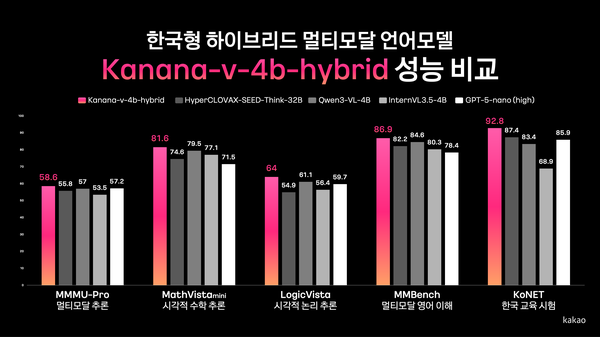
As a result, it scored 92.8 on KoNET, an AI academic assessment benchmark based on South Korea's education system. It also recorded a high correct-answer rate on College Scholastic Ability Test social studies and math problems without missing subtle conditions in Korean.
Kakao also said it outperformed global models in comparisons. Kakao said it recorded strong performance in science, engineering and document understanding compared with similarly sized models such as Qwen3-VL-4B and GPT-5-nano.
Kakao plans to further develop the model so it can assess the complexity of a question and switch on its own between general mode and reasoning mode, without users having to set it separately.
Kim Byung-hak, performance leader for Kakao's Kanana, said, "This model can think and answer most naturally and accurately in a Korean-language environment." He added, "Through the development of a high-performance AI model specialised for Korean, we will boost competitiveness on the global stage and lead the development of the domestic AI ecosystem."
 Lee Ho-jung
lhj@d-today.co.kr
Lee Ho-jung
lhj@d-today.co.kr