
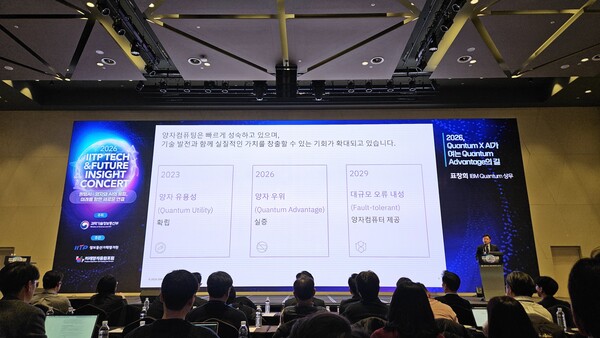
"Quantum computing is no longer a technology of the distant future. This year will be a stage to confirm clearer quantum advantage."
Pyo Chang-hee (표창희), an executive director at IBM Korea, said this on Feb. 24 in a keynote speech at the '2026 IITP Tech & Future Insight Concert' held at Seoul Dragon City by the Ministry of Science and ICT and the Institute of Information & Communications Technology Planning & Evaluation (IITP). Pyo said concrete use cases are likely to emerge as the usefulness of quantum computing has been verified in real industrial settings such as finance, bio and energy.
He especially forecast the arrival of an era of "quantum-centric supercomputing" in which the quantum processing unit (QPU), central processing unit (CPU) and graphics processing unit (GPU) are organically linked. In his analysis, the QPU will help carry out large-scale computations that were difficult with only CPUs and GPUs. IBM is currently working with AMD and Cisco, among others, to implement a quantum-centric supercomputing architecture.
Pyo said quantum computing will become a tool that accelerates computation by combining with existing high-performance computing (HPC). He said it is necessary to create an ecosystem in which quantum, artificial intelligence (AI) and HPC move together.
Pyo said 2026 will be a time to achieve "quantum advantage". Quantum advantage refers to a stage in which quantum computers show verifiable superiority over classical computers in terms of speed, cost and speed, and accuracy. He said quantum advantage is not limited to a specific field and has the potential to spread across all industries, including aerospace, automobiles, finance and healthcare.
A suggestion was also raised that the ability to combine quantum and AI will become national competitiveness in the future. Kim Yoo-suk (김유석), head of Quandela Korea, said the QPU will not drive out existing GPUs and CPUs, but will solve problems by collaborating in areas we cannot currently see. He forecast that efficiently combining GPU, CPU and QPU in AI data centers will improve future competitiveness in AI technology.
He also said it is important to cultivate talent in quantum fields, as early entrants can pre-empt 90 percent of the quantum computer market. Kim added that when quantum-related hardware is commercialised, a country's ability to use it quickly and well should lead to stronger national competitiveness.
The event focused on changes to the industrial landscape that quantum AI will bring under the theme, "Quantum AI: The convergence of quantum and AI, a new connection toward the future". In thematic presentations, Park Kyung-duk (박경덕), a professor at Yonsei University, Kim Eun-sung (김은성), chief technology officer at SDT, Bae Jun-woo (배준우), a professor at the Korea Advanced Institute of Science and Technology (KAIST), Kim Young-sim (김영심), head of IQM Korea, and Jung Geun-hong (정근홍), a professor at the Korea Military Academy, reviewed the current state of convergence between quantum and AI technologies.
Kim Dong-ho (김동호), chief quantum officer (CQO) at MegazoneCloud, introduced demonstration cases of quantum AI and strategies for adoption. Han Nam-sik (한남식), a professor at Yonsei University, and Kwon Tae-ho (권태호), a senior researcher at the Korea Research Institute of Bioscience and Biotechnology, each presented cases of using quantum AI in new drug development and in a bio virtual laboratory.
Koo Hyuk-chae (구혁채), first vice minister of the Ministry of Science and ICT, called QuantumAI a game changer in the global competition for technological hegemony that can complement the limits of digital computing and expand the scope of AI use. He said the government will provide full support to broaden possibilities for use in key areas such as new drug development, new materials, defence and security.
 Jin-ho Lee
jhlee26@d-today.co.kr
Jin-ho Lee
jhlee26@d-today.co.kr