
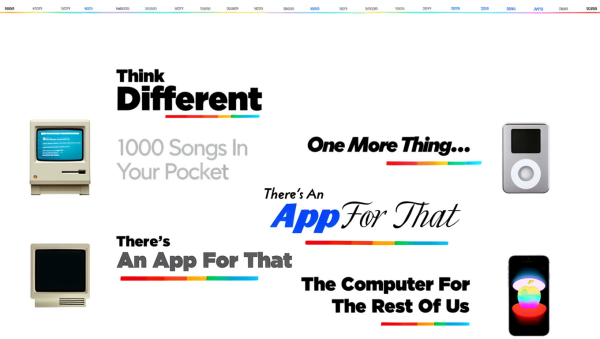
Apple’s past 50 years are a history of innovative products. An analysis said what imprinted the brand even more strongly was “a single sentence”. It said signature slogans, keynote lines and phrases born amid controversy concisely show Apple’s successes and crises.
On April 1, local time, IT outlet TechRadar summed up Apple’s brand evolution in 11 symbolic phrases. It analysed Apple as a company that has designed its identity through sentences rather than product features.
A keyword Apple pushed relentlessly from its early days was “simplicity”. In marketing in 1977, Apple highlighted the message “simplicity is the ultimate sophistication,” differentiating itself in a PC market centred on technology. In 1984, when it launched the Macintosh, it used the line “The computer for the rest of us,” succeeding in expanding computers from a tool for experts to a device for the public.
After Jobs returned in 1997, a line emerged that rebuilt the brand’s identity. The “Think Different” campaign was a kind of challenge to rival IBM’s “Think,” and a declaration that redefined Apple as a rebellious innovator. A message about “the people who believe they are crazy enough to change the world” later became a core narrative of the Apple brand.
From the mid-2000s, ad copy reflected the shift from challenger to a brand that sets the standard. The 2006 “Get a Mac” campaign personified Macs and PCs, using the simple setup, “I’m a Mac… and I’m a PC,” to explain the rivalry and establish Apple as a cool brand.
In the iPhone era, a single-line copy came to symbolise platform strategy. After the App Store’s launch, Apple put the phrase “There’s an app for that” at the forefront of a 2009 advertisement. It drew expectations that any problem could be solved with an iPhone and played a key role in positioning the smartphone as a problem-solving platform rather than a simple device. The App Store in fact surpassed 2 billion downloads within a year of its launch, accelerating ecosystem expansion.
Apple’s presentation culture was also an area where its sentence strategy stood out. Steve Jobs’ “One more thing,” delivered at the end of keynotes, went beyond a simple line and became a device that turned product reveals into dramatic events. Another important message Jobs used repeatedly was “It just works.” It was a line that described the overall Apple experience rather than a specific product, compressing a philosophy that emphasised intuitiveness and completeness.
A single sentence also often worsened crises. During the 2010 iPhone 4 reception controversy, users flagged a problem in which the signal dropped sharply when held in a certain way. Apple responded with “You’re holding it wrong,” drawing criticism that it could be seen as blaming users and dealing a major blow to the brand image. Apple later offered free cases to iPhone 4 users to settle the controversy.
The 2014 “Bendgate” controversy showed a similar pattern. Responding to claims that the ultra-slim iPhone 6 series bent easily, Apple maintained the position that “the number of customers affected is extremely small,” and moved to quell the issue by disclosing its manufacturing and testing processes. The controversy later widened as signs emerged that internally Apple had recognised the iPhone 6 series was more prone to bending than the iPhone 5s.
Fandom and backlash surrounding Apple also became fixed in language. Expressions such as “iSheep” used by critics became symbols that satirised Apple user culture. On the other hand, words that Apple did not create directly but that contributed to ecosystem expansion also appeared, such as “podcast.” The term began as a suggested expression combining “iPod” and “broadcast,” and Apple the following year quickly added podcasts to iTunes, helping drive popularisation.
Ultimately, Apple’s history was a contest not only of technological innovation but of what sentences it would be remembered by. Slogans emphasising simplicity and innovation lifted the brand, while remarks made amid controversy shook that image. As Apple rolls out new products and platforms, how it sums up those changes in a “single sentence” is also expected to be an important competitive strength.
 Jinju Hong
hongjj@d-today.co.kr
Jinju Hong
hongjj@d-today.co.kr