
Pearl Abyss on Monday opened its development site for open-world action adventure game "Crimson Desert" at its new headquarters, "Home One", in Gwacheon, Gyeonggi province. The game is set for a global simultaneous release on March 20, Korea time. The tour covered facilities behind the title, including a motion capture studio, audio rooms and a 3D scan studio.
Home One is Pearl Abyss' new headquarters, with occupancy completed in 2022. It was built from the design stage to create an optimal environment for game development. Development teams for new titles such as Crimson Desert and DokeV, as well as the team building the next-generation in-house engine, the BlackSpace Engine, are based there.
Motion capture studio - 114 cameras linked to the engine in real time for on-the-spot checks
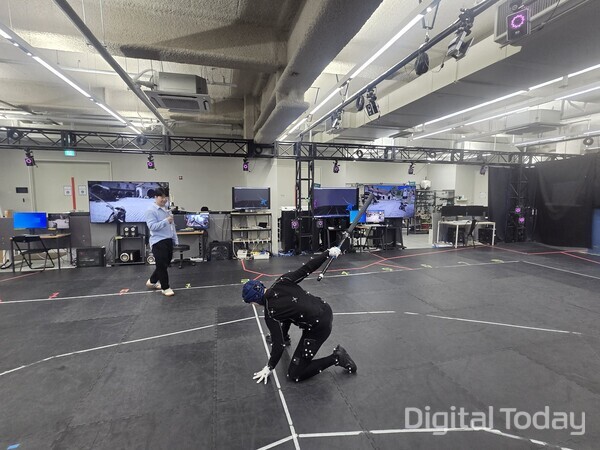
Home One's motion capture studio has 114 optical cameras installed. The optical cameras emit infrared light, recognize light reflected from markers attached to an actor's body and track 3D coordinates in real time.
A key function is real-time linkage with the BlackSpace Engine. As an actor moves, the motion is immediately applied to a game character, allowing the director and actor to adjust actions while viewing results on site. Choi Ki-eon (최기언), head of Pearl Abyss' Directing Action Team, said it is most important to film while watching and communicating because the degree of motion changes greatly depending on whether the action is seen from far away or up close. He added that real-time linkage was chosen because performers change their bearing depending on what kind of character it is and what kind of world it is, and on what outfit they see themselves wearing in a mirror.
At the site, 2 actors demonstrated combat moves with a sword and a staff. The process of motions being reflected in real time in game characters could be seen firsthand. The company explained it has more than 40 types of swords alone, and because an actor's posture changes depending on the weapon's center of gravity, it makes or purchases separate props for each weapon and uses them for filming.
For duel scenes, it uses replica swords made of sponge material, but it uses real weapons in scenes that require reproduction of actual weight. The cast includes musical actors, stunt professionals, dancers and acrobatics specialists, and it has also carried out animal motion capture. A dog was filmed with markers attached together with a trainer, and a horse was filmed by going to an external site.
At Home One, up to 12 people can be filmed simultaneously. A separate space, the art center, has higher ceilings and a larger area than Home One, allowing up to 24 people to be filmed at the same time. Filming that needs more space, such as large objects like dragons and monsters or wire action, is carried out at the art center.
Audio rooms - Foley recording introduced, "a choice for a rough sound and impact"
The audio rooms are where the full process of game sound work takes place, including music, sound effects and voice recording. They consist of 10 independent booths.
The key space is the Foley sound studio. Foley is a method used in commercial film production that applies directly recorded sounds to the game instead of using existing sound libraries. The studio floor is covered with different materials such as sand, grass, gravel and stone, so sounds for different situations, such as footsteps or armor movement, can be recorded on site. Pearl Abyss said it uses the studio when it needs custom sound resources suited to the characteristics of its in-house engine.
At the site, the company showed a case of producing sound for a giant in-game machine. A Pearl Abyss audio room official explained that when thinking about how to record a huge mechanical dragon that does not exist in reality, they thought of an electrical distribution box and tried to bring out a mechanical feeling of flapping wings using something like a washing machine hose. It was a case of reinterpreting everyday objects to create sound for a subject that does not exist.
Ryu Hwi-man (류휘만), audio director at Pearl Abyss, said of combat sound that people working on sound in the same game industry would feel the sound is very rough and coarse, but added it was not because of a lack of skill and was the result after many trials and studies. He described it as a deliberate choice to prioritize impact over refined sound.
BlackSpace Engine technology is also applied to the sound output method. It automatically switches output sounds depending on wind strength and automatically outputs appropriate sounds by calculating material, weight and speed in real time when objects collide. A person in charge cited this as an "audio strength that distinguishes it from other commercial engines". In the existing approach, sounds had to be scripted one by one for each situation, but this system automates sound in a vast open-world environment to improve production efficiency.
3D scan studio - 272 cameras for 360-degree capture, scanning rocks and armor
The 3D scan studio consists of 3 spaces: a full-body scan, a facial scan and a turntable camera booth. Few domestic game companies have such facilities in-house.
The full-body scan booth has 272 cameras arranged in a circle, allowing 360-degree simultaneous shooting of a subject with a single shutter. The facial scan booth has 144 cameras that turn subtle movements of expressions, such as mouth shapes and muscles around the eyes, into data. The results can be checked in real time on a front monitor while working.
The turntable camera booth is used to create 3D resources from natural objects and props such as rocks, tree stumps and relics. The studio stored stones of various sizes, and they were explained as real stones scanned after being collected with cooperation from local governments.
When filming costumes, mannequins are used to fix fabric wrinkles before scanning. When a person wears clothing, the shape of wrinkles changes with movement, making it difficult to accurately turn material texture into data. Through this process, it turns fabric texture, expression wrinkles and even fine scratches on equipment into data, raising game graphic quality while shortening developers' repetitive work time.
7 years of development, March release
Crimson Desert, first unveiled at G-Star in 2019, officially went through 2 release delays and declared "going gold" on Jan. 21. The genre was initially planned as an MMORPG, but was fully revised during development to an "open-world action adventure". Release platforms are PlayStation 5, Xbox Series X|S, Steam, Apple Mac and the Epic Games Store.
Wishlists on major platforms such as Steam have surpassed 2,000,000, and global media including IGN and Gamestar have cited it as a "most anticipated game of 2026". The motion capture studio, audio rooms and 3D scan studio shown on Monday are infrastructure underpinning that anticipation. The release is less than a month away.
 Ho-jung Lee
lhj@d-today.co.kr
Ho-jung Lee
lhj@d-today.co.kr