
[Digital Today reporter Chi-gyu Hwang] "Things go well up to the proof-of-concept (PoC) stage. The problem is what comes next. Once you move into real operations, AI projects stop at many companies."
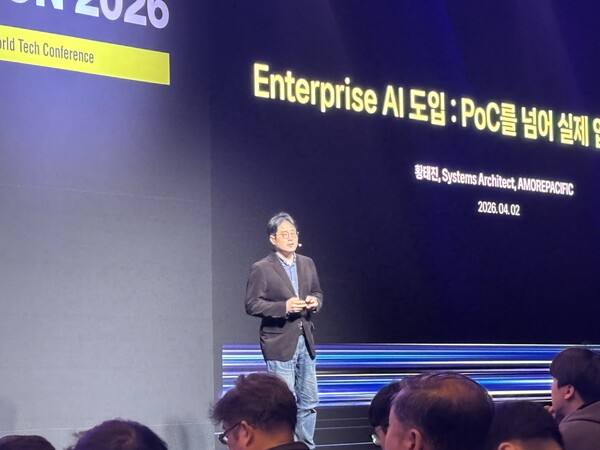
On this, Hwang Tae-jin (황태진), a system architect in charge of AI projects at Amorepacific, pointed to 3 reasons many companies fail to move beyond pilot-level AI.
He stressed in a keynote speech at MegazoneCloud's 'ICON2026' conference with global partners on April 2 that the pace of technological change, the gap between reality and expectations, and problems that arise when applying corporate data to AI are blocking the spread of AI within companies.
On the speed of technological change, Hwang said, "Not long after ChatGPT came out, Gemini appeared, and now Claude is shaking the market." He said, "You can't help but wonder whether it's right to invest now, and whether you can make a decision now when things keep changing."
The gap between expectations and reality can be summed up as the question of why something that worked at home does not work at the company. He said, "Thanks to YouTube and vibe coding, it has become easy for individuals to use AI. But the corporate workplace is different." He said that is why questions such as, "It works at home, so why doesn't it work at the office?" pour in from business users, and it is hard for AI teams to answer.
Data use and costs are also obstacles. Hwang said, "You can't help but feel uneasy about whether internal data will leak outside or be used to train AI models, and the standards for how much authority to give agents are also unclear." He also said, "Token consumption varies greatly depending on the structure of a question, and if you can't manage it, costs increase exponentially." He said that if costs cannot be managed in a situation where companies must prove returns on investment, it becomes difficult to move into the operations stage.
Amorepacific's answer to overcoming these problems and putting AI into real operations was to design AI governance before choosing a model. Hwang said, "AI advancement is possible on a solid design." He said it designed AI governance with a focus on security, access rights and costs and is operating 3 AI agents in production based on that.
Amorepacific is using 3 AI agents: a data extraction agent, an InQ agent and a global network agent.
The data extraction agent is structured so that when a business user requests the data they need in natural language, the AI agent provides an immediate answer. In the past, business users had to ask the operations team for the data they needed, but now they can find it directly and immediately. It was not easy to build. The process of applying a semantic layer was particularly challenging.
Hwang said, "Without a semantic layer, accuracy could not exceed 70 percent." He said it focused on improving accuracy rather than expanding the range of questions, and that it has now applied 16 semantic layers to secure 100 percent accuracy for those question types.
The InQ agent is based on retrieval-augmented generation (RAG) and learns internal manuals, with the key aim of having it handle general inquiry tasks that the operations team used to process. Hwang said, "The agent handles 50 percent in place of people, reducing the operations team's burden by that much."
Amorepacific runs its global subsidiary network from its South Korean headquarters. Because of time differences, it was difficult to respond immediately to requests from U.S. or European subsidiaries. Hwang explained that it built an environment where the global network agent receives inquiries coming in via Jira, answers them based on what it has learned, or directly controls heterogeneous systems to carry out simple actions such as password resets. He stressed that, "All 3 agents were developed after completing the governance design first."
Hwang also advised that companies need to first answer several questions before adopting agents. For example, whether to view an agent as a simple tool or as a system; whether to give authority to the agent or to the data, or to control both; and whether to view costs by service or by user.
Hwang said, "Amorepacific chose to view agents as systems, control both authority and data, and look at costs at both the service and user levels." He said, "The most important thing in adopting enterprise AI is not technology. It is creating a structure that can be operated sustainably, and that structure is possible when AI governance is properly in place."
 Chi-gyu Hwang
delight@d-today.co.kr
Chi-gyu Hwang
delight@d-today.co.kr