
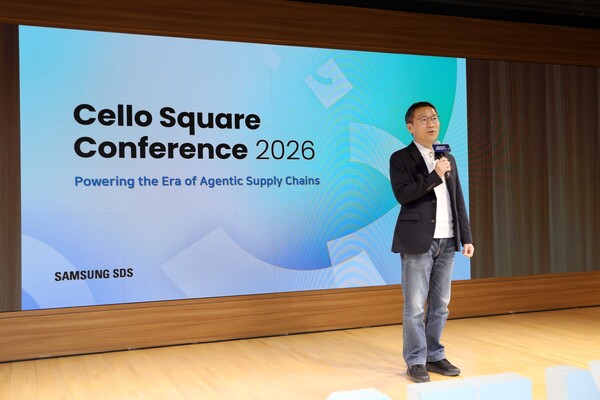
Samsung SDS held the Cello Square Conference 2026 at its Pangyo logistics campus on April 2 under the theme of the agentic AI supply chain era.
The event invited about 120 shipper companies, including manufacturers and retailers, to share strategies for responding to global supply chain risks and key trends and cases expected to have a major impact on the logistics industry.
Samsung SDS said it used generative AI to analyse a range of structured and unstructured data, derived 10 meaningful trends and, based on those, added its logistics expertise to organise three core insights.
In a keynote, Oh Goo-il (오구일), head of Samsung SDS' logistics business division and a vice president, presented an automated control tower capable of decision-making, the rise of digital twins that support complex decision-making and an expansion of total-cost-based decision-making that considers all direct and indirect logistics costs. He introduced cases that are gradually advancing at logistics sites.
The company said the automated decision-capable control tower is an intelligent operating system that integrates real-time data across the full supply chain process, including production, transport and inventory, to secure visibility. It uses AI-based analysis to detect and respond in advance to abnormal situations such as demand fluctuations or transport delays.
Through this, companies will shift from simple monitoring to operations that combine forecasting, pre-emptive responses and autonomous decision-making.
As global supply chains grow more complex and collaboration expands among warehouse workers, automation equipment and AI, the importance of digital-twin-based simulation is increasing to allocate appropriate roles and design processes. Samsung SDS forecast wider use of digital twin simulations to quickly review various alternatives and derive the optimal option to respond to variables that arise in real logistics operating environments.
Decision-making centred on "True Cost" is expanding by reflecting not only traditional costs such as freight and tariffs but also various variables including carbon emissions, supply chain risks and the opportunity cost of cargo during transport. The company stressed that this leads to supply chain strategy development that considers stability and sustainability alongside cost reductions.
Oh said Samsung SDS plans to combine abundant on-site data and advanced AI technologies to help customers make fast decisions and build resilient supply chains.
 Chi-gyu Hwang
delight@d-today.co.kr
Chi-gyu Hwang
delight@d-today.co.kr