
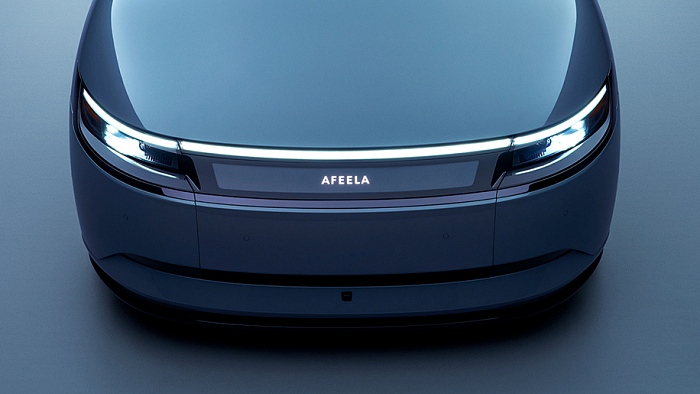
Sony Honda Mobility, the joint venture between Sony and Honda, has suspended its electric vehicle project and begun reviewing its business direction. The company said it would halt development and launches of the Afeela 1 and 2 (Afeela 1 and 2), and would announce its plans as soon as possible after reviewing its future business direction.
Behind the decision is a deterioration in Honda's EV business environment. Honda booked losses of up to $15.7 billion after writing off part of its EV investment on March 12, and a shift in U.S. policy toward fossil fuels, the abolition of EV tax credits and the imposition of tariffs were reported to have affected the business.
• Sony-Honda halts Afeela EV project; reviews business direction
Another Japanese auto brand, Toyota, is also showing both a sense of crisis and expanded investment. Toyota CEO Koji Sato (사토 코지) warned of a sense of crisis across the auto industry, saying, "Without change, survival is difficult," and said it would push to relax production standards.
Toyota is investing $1 billion in a U.S. plant and pushing to introduce new models, appearing to speed up its response to electrification. It is pursuing a plan to integrate Lexus plants and convert its Indiana plant into a Lexus production base, and the possibility of producing Subaru electric SUVs is also being discussed.
• Toyota CEO: "No survival without change"; sense of crisis rises in auto industry • Toyota to invest $1 billion in U.S. plant; to add new models after Highlander EV
With winter testing completed for the electric vehicle 'ID Every1' (ID EVERY1) being co-developed by Rivian and Volkswagen, Volkswagen will invest an additional $1 billion in Rivian.
• Rivian secures an additional $1 billion investment from Volkswagen
Google has moved to secure control of vehicle software by fully opening Android Automotive OS. The strategy seeks to expand influence beyond simple infotainment to the vehicle "brain," as software competition in the auto industry intensifies. Google Maps also introduced an EV route planning function that factors in charging stop time.
• Google fully opens Android Automotive OS; moves beyond the dashboard to control the vehicle 'brain' • Google Maps adds EV route planning on Android Auto; calculates charging stop time
Competition across the industry over leadership in robotaxis and autonomous driving technology is also intensifying. Waymo's robotaxis expanded their operating scale 10-fold in just 2 years, surpassing 500,000 weekly rides in 10 U.S. cities. With the release of data saying the service is 92 percent safer than humans, an assessment has emerged that autonomous driving commercialisation has moved beyond the experimental stage and entered a phase of full-scale expansion.
• Waymo robotaxis grow 10-fold in 2 years; top 500,000 weekly rides in 10 U.S. cities • '92 percent safer than humans'; Waymo proves autonomous driving safety
Amazon self-driving unit Zoox is expanding robotaxi services to Miami and Austin, and WeRide is pushing into Hong Kong and Singapore, as global competition begins in earnest. General Motors has also started 'eyes-off' test drives, adding to the sense that the fight for leadership in autonomous driving commercialisation is accelerating.
• Amazon's Zoox expands robotaxi services; launches in Miami and Austin • WeRide pushes services in Hong Kong and Singapore; Chinese robotaxi expansion accelerates • GM begins autonomous 'eyes-off' test drives; first applied to Cadillac Escalade IQ
Market assessments are mixed on Tesla's autonomous driving strategy and earnings outlook. With robotaxis facing a setback after being classified by U.S. authorities as limousines rather than self-driving vehicles, the market remains cautious even as first-quarter vehicle deliveries are expected at 360,000.
• Tesla robotaxi 'braked'; U.S. authorities: "Not self-driving, but a limousine" • Tesla seen delivering 360,000 vehicles in the first quarter, but market remains 'cold'
Tesla's large-scale AI project 'Terafab' is nearing full operation. As Elon Musk seeks to secure talent, speculation about a 2027 merger with SpaceX is also being mentioned, drawing attention to possible project cooperation.
• Elon Musk's 'Terafab' nears launch; talent drive accelerates, what is the salary? • Tesla-SpaceX 2027 merger speculation; will they cooperate on the 'Terafab' project?
Tesla is continuing a range of changes amid technological innovation and controversy. It is improving infrastructure efficiency with a foldable Supercharger, while issues over an FSD hacking tool and door system improvements have surfaced at the same time, increasing attention to safety and security. Talk of a possible new family car has also emerged following Musk's remarks, with changes being detected across product strategy and the overall user experience.
• Tesla unveils foldable Supercharger; installation time halves, costs drop 20 percent • Unsealing FSD in 5 minutes? A 'hacking tool' shakes the Tesla community • A new family car from Tesla? Interest focuses on a remark by Elon Musk
In South Korea's used-car market, the Ioniq 5 and EV6 are strong while Tesla is weak, making the polarisation in prices clearer.
Kakao Mobility appears to be expanding mobility services into everyday life by introducing a service that calls a taxi on behalf of hospital users.
• Polarisation in used EV prices; Ioniq 5 and EV6 up, Tesla down • Kakao Mobility introduces 'call a taxi instead' at Seoul National University Bundang Hospital
The competitiveness of Chinese EVs is spreading across the industry beyond price. They are securing technological and scale competitiveness beyond simple value for money, threatening Western companies facing pressure on profitability.
CATL's founder warned that the U.S. EV industry would also struggle to grow without China, adding to concerns that global EV supply chains and market leadership could be reshaped around China.
• "Beyond cheap and good"; Chinese EVs become the mainstream, while the West sinks into an 'loss swamp' • "U.S. EVs cannot grow without China"; CATL founder warns
Asus (ASUS) unveiled its new conversion kit, the E250G1, which turns existing bicycles into e-bikes, marking a full entry into the e-bike market. The product has a detachable 159Wh battery and a maximum range of about 51 km, and offers three riding modes: Eco, Normal and Sport.
Rilax (Rilax) introduced its new smart helmet, the RU-1 Pro (RU-1 Pro), with enhanced multi-connection features. It can connect up to 8 riders simultaneously and supports stable communication over distances of about 2,000 metres.
• Why would a computer company? Asus releases an ultra-light, ultra-simple e-bike conversion kit • Up to 8 connected at once; Rilax unveils advanced smart helmet 'RU-1 Pro'
 Jinju Hong
hongjj@d-today.co.kr
Jinju Hong
hongjj@d-today.co.kr