
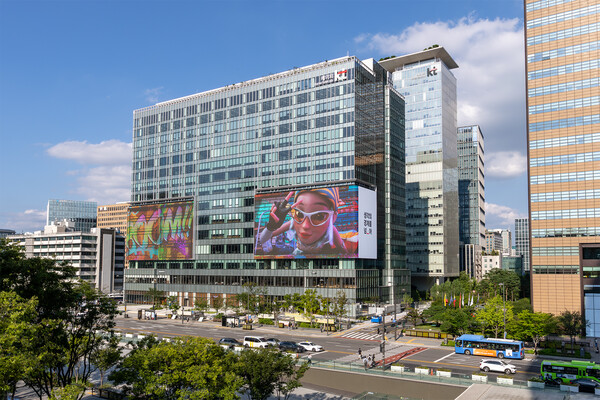
KT said on Monday it will carry out a 2026 organisational overhaul and executive appointments to become South Korea's No. 1 "AX platform company."
KT said the overhaul and appointments focus on bold personnel renewal, improving management efficiency and strengthening field management centred on customer service and quality. It said it will reshape itself into a more agile organisation and drive future growth by promoting talent based on expertise and performance.
EXECUTIVE RANKS CUT ABOUT 30 percent; KEY DEPARTMENT HEADS REPLACED
KT said it replaced department heads reporting directly to the CEO and carried out a high-intensity personnel shake-up, appointing younger leadership in its B2B, AX and AI businesses.
Kim Bong-gyun (김봉균), chief executive of KT Engineering and born in 1972, was promoted to executive vice president as head of the enterprise division to oversee its B2B business. Ok Gyeong-hwa (옥경화), head of the IT platform unit, was promoted to executive vice president as head of the IT division, becoming KT's first female executive vice president, and is set to oversee IT technology.
KT also appointed internal talent to key posts. It named Park Hyun-jin (박현진) as head of the customer division. Park is a B2C specialist who has led key headquarters in the customer division and served as chief executive of group content affiliates, including Milie's Library. Park returned to KT after being promoted from senior executive to executive vice president.
KT promoted Kim Young-in (김영인), a telecommunications infrastructure specialist with experience across building and operating wired and wireless networks and overall quality management, to executive vice president and appointed him head of the network division.
KT said it plans to recruit experts recognised in the industry to enhance business competitiveness and advance management controls such as compliance management. It said it will sharply cut its existing executive-level organisation by about 30 percent to improve efficiency and strengthen business competitiveness by speeding up decision-making and execution.
INFORMATION SECURITY OFFICE INTEGRATED, STRENGTHENED; AI R&D REORGANISED INTO AX FUTURE TECHNOLOGY INSTITUTE
KT also said it will integrate dispersed security functions across IT and networks into its information security office and focus on upgrading its security system to the highest level through innovation centred on the chief information security officer, or CISO. It recruited Lee Sang-woon (이상운), a security expert who has more than 30 years of experience in information protection and the full range of financial IT at Korea Financial Telecommunications and Clearings Institute, as head of the information security office and CISO.
To boost technology leadership and expertise, KT will separate AI research and development and IT functions that had been operated in an integrated way. It will reorganise its R&D organisation into the AX Future Technology Institute to strengthen next-generation technology development and focus on securing differentiated AI technology. Company-wide IT governance, platform operations and upgrading IT infrastructure will be handled by a newly created IT division.
KT also plans to sharply strengthen network infrastructure investment and specialised personnel to upgrade its telecommunications and IT quality to the highest level. It will increase facility investment to improve wireless network quality and reinforce field specialists dedicated to network operations and maintenance.
NEW AX BUSINESS DIVISION; REGIONAL HEADQUARTERS CONSOLIDATED TO 4 FROM 7
KT will create a new AX business division to strengthen competitiveness and accelerate growth in the B2B AX field. Park Sang-won (박상원), who will be recruited as head of the division, is a former head of Samjong KPMG Consulting and an AX consulting specialist covering strategy, technology and business execution. KT said it plans to build an AX expert group led by Park to guide AX transitions for domestic public-sector and corporate customers and expand its market position.
In B2C, KT will integrate its media division into the existing customer division. It said the aim is to accelerate customer experience innovation across wired and wireless telecommunications and media and respond nimbly to market changes.
KT said it will broaden its existing system of seven integrated regional headquarters into four regions - Seoul metropolitan north, Seoul metropolitan south, east and west - and bring them under related business divisions directly reporting to headquarters, including B2C, B2B and network operations, to increase alignment between headquarters and the field. Seven customer headquarters that handled B2C business in the existing regional headquarters will be incorporated into four headquarters under the customer division. The corporate customer headquarters will move into the enterprise division, while the network operations headquarters will move into the network division.
A KT official said the changes are expected to strengthen field support and lead to tangible market results in areas that require close communication at the company-wide level, including B2C, B2B and networks.
KT will also abolish the total sales centre organisation that carried out direct sales in the field and reassign staff across the field where manpower is lacking. It plans to increase personnel not only for sales work but also for customer service support and information security inspections. It will reorganise staff organisations such as the public relations office, CR office and SCM office into organisations reporting directly to the CEO to enhance expertise and risk response capabilities.
KT Chief Executive Yoon-young Park (박윤영) said strengthening the core competitiveness of telecommunications, or a "solid foundation," is the starting point for restoring customer trust and innovation. He said KT will concentrate company-wide capabilities to build a virtuous cycle of "certain growth" by maximising hyper-personalisation and industry-specialised AX capabilities and to become South Korea's No. 1 AX platform company.
 Jin-ho Lee
jhlee26@d-today.co.kr
Jin-ho Lee
jhlee26@d-today.co.kr