
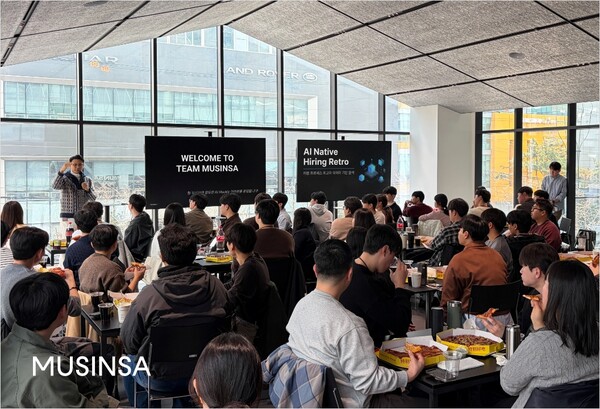
Musinsa has wrapped up an open recruitment process for “artificial intelligence native (AI-native)” entry-level developers and placed 66 successful hires into business units, it said on Sunday.
The recruitment was a large-scale intake of entry-level developers held for the first time in 4 years as part of the “Musinsa Rookie (MUKIEs)” program led by Musinsa’s tech division. Musinsa introduced a simplified application process without the usual document screening, and about 2,000 people applied, it said.
Musinsa said it focused its assessment on candidates’ ability to solve practical problems by using AI tools proficiently, beyond basic coding skills. It ran a three-stage screening process, starting with a first coding test involving more than 700 participants. That was followed by a second test to verify AI tool proficiency involving 400 people, and a final third-stage offline interview involving 100 people. It ultimately selected 66 candidates. The pass rate was about 3.3 percent.
The 66 entry-level developers placed into business units will be assigned immediately to Musinsa’s live tech projects. The new hires are expected to carry out real commerce projects aimed at resolving inconveniences experienced by Musinsa customers, rather than completing training-only assignments. The company said they will take part in practical projects over the next 6 months and lead efforts to improve system efficiency using AI technology.
After that, reviews for conversion to permanent roles will be conducted as an absolute evaluation centered on individual capability and contribution, rather than a relative assessment. If a candidate proves their capability, the process will proceed without a headcount limit. The company said it aims to create an environment where junior developers can focus solely on growth.
Jeon Jun-hee (전준희), Musinsa’s chief technology officer, said, “We will provide full support so that the 66 entry-level developers who passed through fierce competition can use AI as a tool to drive innovation in the fashion tech ecosystem.” He added, “We plan to continue investing in tech talent and technology-based innovation.”
 Shin-hye Ahn
doubletap@d-today.co.kr
Shin-hye Ahn
doubletap@d-today.co.kr