
POSCO Future M has moved to strengthen governance by setting up a new board-level committee, after shoring up its growth base through anode material orders and business diversification despite external uncertainty.
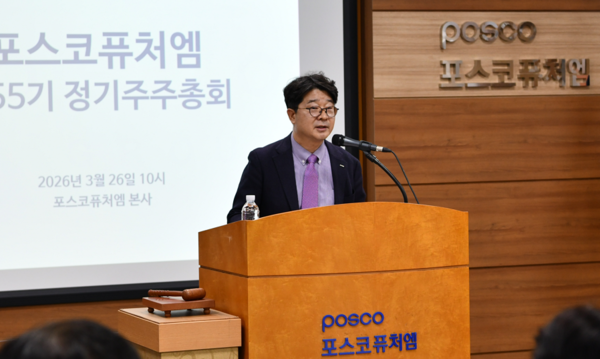
On March 26, the company said it held its 55th annual general meeting and reappointed Eom Gi-cheon (엄기천) as CEO. Eom said, "This year as well, we will actively pursue performance improvement and boosting shareholder value by pushing ahead with proactive investment such as building a new anode material plant in Vietnam and by diversifying our customer and product portfolios."
POSCO Future M signed anode material supply contracts worth a total of 1.7 trillion won with global automakers in October last year and this month. It expanded the scope of orders from natural graphite anode materials last year to artificial graphite anode materials this year. It decided to build a new anode material plant in Vietnam in response to supply requests from customers, and it has confirmed an investment in spherical graphite in Saemangeum to accelerate the establishment of a self-sufficient anode material supply chain.
It also expanded its future business areas. It signed an MOU for technology development and an investment agreement with U.S. all-solid-state battery company Factorial in November last year and January this year, and moved to preempt the all-solid-state battery market for aviation mobility, high-performance electric vehicles and humanoids. To respond to demand for energy storage systems (ESS) such as for AI data centres, it will build an LFP cathode material plant in Pohang and remodel part of its existing high-nickel cathode production lines, with supply set to begin in the second half of this year.
At the shareholders' meeting, it also approved amendments to its articles of incorporation to create new board committees. An ESG Committee and an Evaluation and Compensation Committee will be established, and both will be made up entirely of outside directors to ensure independence. The ESG Committee will independently review key agenda items such as ESG strategy and governance changes and present its views to the board, while the Evaluation and Compensation Committee will deliberate on executive performance evaluations and compensation policy based on objective criteria.
The company said the two committees were approved by the board in November last year and were incorporated into the articles of incorporation following shareholder approval. It said this has increased transparency and independence in decision-making and strengthened a stakeholder-interest-centred decision-making structure.
There were also changes to the board. Lee Sang-young (이상영), a professor in Yonsei University's Department of Chemical and Biomolecular Engineering and an expert in secondary battery materials, was appointed as a new outside director, while outside directors Yoon Tae-hwa and Lee Bok-sil were reappointed. Kim Sung-jin, head of the Planning and Support Division, was appointed as an inside director, and POSCO Holdings' Jeong Seok-mo, head of the Business Synergy Division, was appointed as a non-executive director. In addition to the election of directors and the creation of the new committees, a total of six agenda items were handled, including approval of the 55th financial statements, amendments to the articles of incorporation following revisions to the Commercial Act, election of audit committee members and the ceiling on directors' remuneration.
 Seok Dae-geon
d2dg@d-today.co.kr
Seok Dae-geon
d2dg@d-today.co.kr