
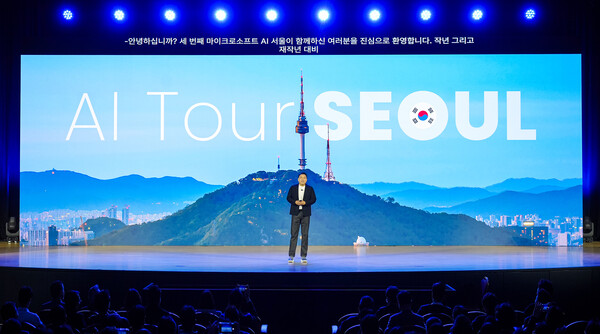
Microsoft on Wednesday held its AI Tour Seoul event and unveiled its frontier transformation strategy and a supporting framework. The strategy focuses on helping South Korean companies redesign processes with AI, beyond simple productivity gains.
Microsoft also introduced examples of South Korean companies that have put its framework into practice. Cases shared included KT, Hyundai Department Store Group, Yonsei University Health System, RealWorld (RLWRLD), Hyundai AutoEver, Hanwha Qcells and Enhance.
KT is a case in which the company turned AI into an important organisational asset by introducing Microsoft 365 Copilot.
KT built a system that lets employees design customised AI agents tailored to their roles and tasks by centralising internal data and building an integrated environment.
That has led to better employee experience and changes in the way people work. Introducing AI solutions not only improves employee productivity but also raises efficiency across tasks, having a positive impact across the company, the company said.
Kim Hoon-dong (김훈동), head of the AXD division at KT's Strategic Business Consulting unit, said in a keynote speech that KT supported employees so they can directly conceive and design AI agents optimised for specific roles and workflows, in order to turn gains in individual productivity into shareable, company-level value. He said KT is seeing results and will manage Microsoft's AI solution lifecycle more systematically to convert individual work into organisational value.
Hyundai Department Store Group revamped the offline customer experience through HEYDI, a shopping curation service based on Azure OpenAI.
With context-aware recommendations and multilingual support, it recorded a customer satisfaction score of 4.51 points. HEYDI use rose 9-fold to 80,000 cases a month from 9,000 a month at launch.
Kim Seok-hoon (김석훈), a head at Hyundai Futurenet, Hyundai Department Store Group's ICT-specialised company, said that because its very large offline stores attract customers from around the world, there were operational limits in consistently delivering a customer experience to each customer with different languages, purposes and preferences. He said that since HEYDI's launch, it has confirmed visible results such as visits leading to actual purchases and enabling deeper interactions with customers.
Yonsei University Health System built a "citizen developer" environment in which frontline medical staff directly develop AI apps, integrating more than 80 specialised apps into clinical workflows. Through a "Rounding Copilot" scheduled for introduction in April, it expects to shorten chart review time and secure up to an additional 1.8 hours a day in consultation time per doctor, improving the quality of medical services.
Yun-bin Jeong (정윤빈), deputy head of Yonsei University Health System's Information Service Center, said strict medical regulations and security requirements had made it difficult in terms of time and cost to quickly translate clinical-field requirements into AI solutions. He said the organisation is working with Microsoft to build a safe, scalable development environment and expects this will reduce clinicians' workload and repetitive routine tasks and sharply improve treatment efficiency.
RealWorld, a physical AI-based robotics technology company, is working with Microsoft to advance physical AI technologies, including robot manipulation models. RealWorld is building infrastructure to systematically store and manage industrial data based on Azure Blob Storage and Azure Data Lake, boosting the efficiency of model training and repeated experiments. It plans to support corporate customers so they can more safely test and deploy physical AI in manufacturing and logistics environments through an industrial data sandbox.
Jung-hee Ryu (류중희), chief executive of RealWorld, said that to implement a physical AI robot model integrating perception, movement and control, sophisticated manipulation data reflecting real industrial environments and infrastructure to use it reliably are important. He said he expects the partnership with Microsoft will strengthen the foundation for using data suited to manufacturing and logistics sites and gradually expand verification and application of physical AI technology.
Hyundai AutoEver introduced GitHub Copilot to create an effective development collaboration environment and increase development speed. AI-based acceleration of development productivity is also seen in growth in South Korea's developer ecosystem. According to GitHub's Innovation Graph, the South Korean developer community has surpassed 2.72 million people and has continued to grow steadily since 2020, expanding its influence in global open-source and AI development.
Young-choon Park (박영춘), head of Hanwha Qcells' G&ES business division, and Seung-hyun Lee (이승현), chief executive of AI startup Enhance, also took the keynote stage and shared, respectively, an AI-based energy management service and an AI agent platform strategy through cooperation with Microsoft.
 Chi-gyu Hwang
delight@d-today.co.kr
Chi-gyu Hwang
delight@d-today.co.kr