
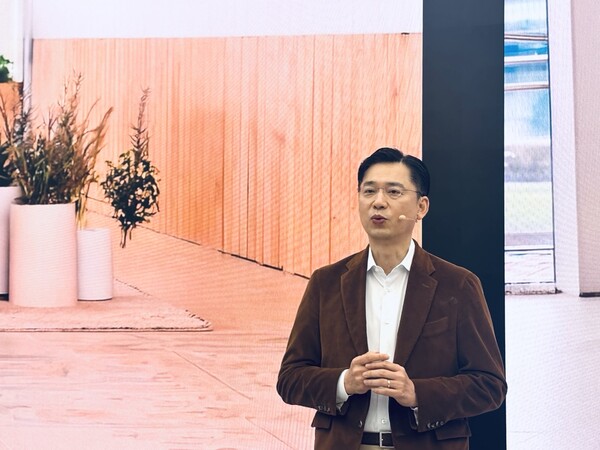
Samsung Electronics has launched its 2026 Bespoke AI Combo. It has the country’s largest capacity, with 25 kg for washing and 20 kg for drying. On a rapid course, it completes washing through drying in 69 minutes. Samsung Electronics on Wednesday unveiled a new appliance strategy targeting newlyweds, including the 2026 Bespoke AI Combo washer, at a media briefing at Samsung Gangnam Store.
The 2026 model structurally redesigns the heat exchanger system. It adds a “booster heat exchanger” to the rear of the product next to the main heat exchanger. The change increases heat dissipation while effectively controlling internal temperature, lifting drying capacity by 2 kg from the previous model. It also newly designs a method to separately mount the rear booster heat exchanger and distribute control of internal temperature.
It also applies a “Pre-heat” method developed from the existing hybrid heat pump approach. Under the prior method, the heater was operated after the drying process began to raise the internal temperature. The new model starts drying with the heater operated in advance from the wash spin-dry stage, maximising heat exchanger performance at the start of drying. It shortens overall drying time and cuts power consumption by up to 35 percent.
Seong Jong-hoon (성종훈), an executive director in the DA division, said the third-generation heat exchanger installs a booster heat exchanger on the rear to efficiently control heat dissipation and internal temperature. He said it maximised dehumidification efficiency without reducing drying performance for large loads.
The briefing also addressed reduced drying performance in winter. The heat pump method has a structural limitation in which drying slows because it takes time for the compressor to reach normal performance when outdoor temperatures are low. The new model compensates by detecting low ambient temperatures, preheating the compressor and then starting the drying cycle.
AI functions were also upgraded. It is equipped with Bixby based on a large language model, allowing users to control the product through natural-language conversation. Users can also receive voice guidance for setting wash reservations, course recommendations and instructions on how to use the product. It also includes “AI Custom+,” which automatically sets the optimal course by detecting fabric weight, type and soil level, and an “AI vibration and noise reduction system” that optimises vibration and noise by detecting floor conditions.
Kim Yong-hoon (김용훈), head of the CE team, said experience controlling washers via mobile phones through SmartThings is gradually spreading overseas, increasing the share of purchases that consolidate the Samsung brand. He said AI home appliances have moved beyond being “inside the body” to a level that “feels real on the skin.”
Samsung Electronics said its analysis of AI home appliance user feedback found high satisfaction with the experience of AI resolving issues even in areas users do not recognise.
Samsung Electronics is positioning the newlywed market as a core strategy this year.
According to Samsung Electronics, the share of AI Combo purchases in newlywed wedding packages expanded to 46 percent last year from 35 percent in 2024, and it expects that to top 60 percent this year. It viewed the product as shifting, within two years of launch, to the first choice in newlywed appliance purchases, overtaking refrigerators.
Bespoke AI Combo global sales in 2025 grew 50 percent from a year earlier, while domestic sales rose 36 percent. Lim Seong-taek (임성택) said refrigerators used to have the biggest influence when choosing appliances for newlyweds, but washer-dryers have now become the most important appliance. He said the goal is to make the first appliance he or she chooses the starting point of the AI home experience.
Samsung Electronics also addressed connectivity with other companies’ appliances. It said it prioritises security over excessive connectivity. Seong said as the number of internet-connected devices grows and appliances add even camera-equipped products, linking with other companies carries large security risks. He said it is currently focusing on connections among Samsung products based on Knox Matrix. It will continue some third-party connectivity through HCA (Home Connectivity Alliance) technology.
Its distribution strategy will also be reorganised around newlywed demand. Starting with Samsung Store Cheongdam, it will sequentially expand “wedding specialty stores” centred on regional hub cities. It will also place newlywed appliance consultants at 160 stores nationwide to build a one-stop consultation system. Lim said the goal is to ensure people in the regions do not have to come to Seoul for wedding packages.
 Daegeon Seok
d2dg@d-today.co.kr
Daegeon Seok
d2dg@d-today.co.kr