
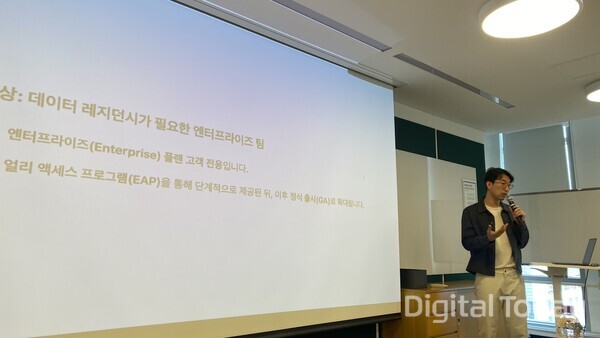
Notion signals it will launch a domestic data residency offering in South Korea this fall and step up its push into the AgentOS market.
At a media roundtable held on March 25 at Notion Korea's office in Seoul's Gangnam district, Notion Korea country manager Daesung Park (박대성) said, "Data residency is a starting point for implementing AgentOS." He said companies must be able to upload data to Notion with confidence for agents to function properly.
Notion's AgentOS concept is an operating system in which AI agents autonomously carry out tasks based on an in-house knowledge base. It is a structure where people and agents work together in the same work environment. Notion has been known as a personal productivity tool or a collaboration tool for startups, but it has secured major domestic corporate clients such as GS Group, Nexon, Toss and LG Group affiliates, and has established itself in the enterprise market. Notion said it aims to use that as a foothold to become an AgentOS platform.
Park said companies need a space to collect internal information and for people and agents to interact, and Notion will support that under its AgentOS direction. He described it as an OS concept where people can build agents using their company's internal information, share them, assign roles or delete them.
Notion cites its markdown-based data structure as a technical differentiator in the AgentOS race. It said the structure contains only content and structure without unnecessary formatting code, allowing AI to grasp context more accurately. Park said retrieval-augmented generation, or RAG, built on existing data structures has a very high probability of failure. He said the era has arrived in which software-as-a-service providers built on markdown structures will be assigned more value in the AI age.
Notion said the goal on top of that structure is a shift to autopilot, where agents handle tasks without human involvement. If the concept so far has been copilot, where AI assists people, autopilot is the stage where AI independently completes tasks. Park said when an employee with outstanding AI skills creates an agent, it should become a colleague for the entire organisation.
Notion said the background to launching a Korea region is domestic demand for its custom agent, launched earlier this year. The custom agent is an AI agent builder that enables task automation, Q&A and report generation based on in-house data without coding. Of custom agents created so far, 30 percent came from the Asia-Pacific region, and South Korea accounted for about 10 percent.
Park said, "The reaction in Korea is explosive." He said a Korean company is included among its global top five clients, and that client created more than 1,000 agents in just 2 weeks after adoption. He said it had the same effect as hiring 1,000 new employees. Notion said this is also why it chose Korea ahead of Singapore and Japan after the United States and Europe.
The data residency offering will officially launch this fall. After that, enterprise customers will be able to choose the Korea region as an option. Notion said it has also obtained certifications to meet the security levels of demanding corporate clients. It said it has completed international standard certifications including SOC 2 Type 2 and ISO 27001, and has also completed and renews annually a cloud service provider safety assessment certification overseen by South Korea's Financial Security Institute.
Park said customers in the finance and public sectors are also increasing after the security certifications. He said there were many customers who wanted to use Notion but could not due to regulations, and that data residency will be an important turning point that resolves those constraints.
Notion also emphasised that it applies a zero-retention policy in which large language model providers do not store data in the process of transmitting data to external LLMs when AI functions run. Park said it is already legally and contractually confirmed that data is sent but not stored anywhere and is immediately deleted.
Not all data is stored in South Korea. Notion said corporate sensitive information such as user-generated content, uploaded files, search indexes and audit logs will be stored in South Korea, while account information and analytics data will remain on servers in the United States.
 Seulgi Son
sageson@d-today.co.kr
Seulgi Son
sageson@d-today.co.kr