
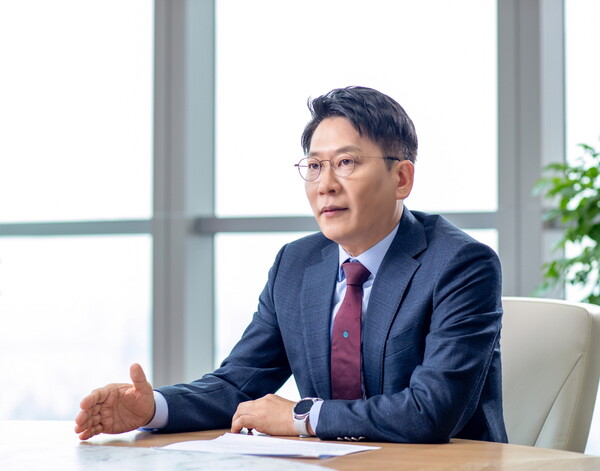
LG Energy Solution is pushing an AI-driven transformation with a goal of improving productivity by at least 30 percent by 2030.
LG Energy Solution said in CEO Kim Dong-myung's New Year message on Sunday that it will make 2026 the first year of a shift to tangible business performance. The company will focus on four core tasks to deliver customer value. The key tasks are realising growth potential in the ESS business, product strength and cost innovation, strengthening R&D competitiveness, and accelerating AI-based execution.
Kim said the company, which marked its fifth anniversary in December, has pursued portfolio rebalancing and strengthening structural competitiveness. Citing achievements including orders in the ESS and EV sectors and stabilising its profit structure, he stressed that despite difficult market conditions, the company must turn its existing efforts into business results.
For its ESS business, it will expand production capacity to meet growing demand. It plans to strengthen solution competitiveness by boosting differentiated capabilities in SI and SW. It will accelerate a shift to ESS in North America, Europe and China to ensure timely supply, while improving supply stability and operational efficiency at the same time.
It is also moving to secure product strength and cost competitiveness. To gain an edge in core products such as 46-series cylindrical batteries for EVs, HV Mid-Ni pouches, and prismatic LFP for ESS, it will cut material and processing costs through materials and process innovation. It will also strengthen structural cost competitiveness through investment to secure raw materials and building a recycling base.
R&D will focus on technologies that directly link to business results, including dry electrodes, High-Ni 46 cylindrical batteries and HV Mid-Ni. It will strengthen EMO capabilities to improve available energy for ESS and prediction of remaining life. It will also continue to secure next-generation all-solid-state battery technology. It plans to build a global R&D system tailored to country-specific characteristics to speed up technology commercialisation.
Finally, it defined an AI and DX shift as a task for survival. The company will fully apply AI to three key areas: product development, materials development and manufacturing operations. It will improve productivity by at least 30 percent by 2030 and bring forward the target timeline. Kim said, "Let us move as one team through collaboration without boundaries between departments and prove customer value."
 Seok Dae-geon
d2dg@d-today.co.kr
Seok Dae-geon
d2dg@d-today.co.kr