
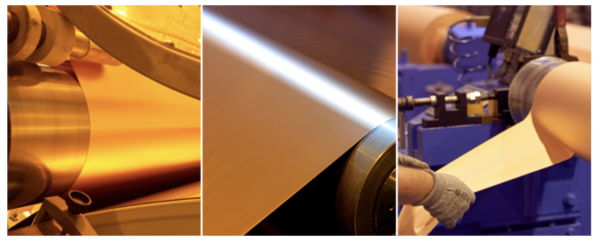
Solus Advanced Materials said on Monday it has completed development of a nickel-plated copper foil (Ni deposited copper foil) current collector, a key material for all-solid-state batteries, and has begun scaling up for mass production. The company plans to secure both technological and cost competitiveness to target the all-solid-state battery commercialization market around 2027.
All-solid-state batteries are divided into sulfide-based, oxide-based and polymer-based types depending on the solid electrolyte used. Among them, sulfide-based types have the highest potential for commercialization in terms of ionic conductivity and process efficiency. But sulfur (S) in the electrolyte reacts with conventional copper foil and causes corrosion, and securing material technology to overcome this has been cited as a prerequisite task.
The nickel-plated copper foil developed by Solus Advanced Materials is a material that suppresses corrosion reactions by ultra-precisely plating nickel on copper while maintaining copper's inherent electrical conductivity and cost competitiveness. The company explained it was developed to address rising costs and lower process efficiency that occur when pure nickel foil is applied.
The company succeeded in implementing zero-pit plating that uniformly covers the entire surface even on ultrathin foil of 500 nanometers (nm) or less through its proprietary plating technology. It removes pits, a type of surface defect that is more likely to occur as the plated layer becomes thinner.
The technology is being developed not only to suppress corrosion in sulfide-based all-solid-state batteries but also to support anode-less battery structures. The anode-less battery technology aims to suppress dendrite growth through surface treatment to improve battery stability and extend life. The company plans to continue R&D on current collectors for next-generation batteries and strengthen its technological competitiveness in the global market.
A Solus Advanced Materials official said, "Our ultrathin nickel-plating technology is a concentration of high-level technologies that satisfies both chemical stability and economic feasibility." The official added, "Through next-generation battery response projects, we are precisely implementing the physical properties customers require while continuously strengthening our R&D capabilities."
 Daegeon Seok
d2dg@d-today.co.kr
Daegeon Seok
d2dg@d-today.co.kr