
[DigitalToday reporter Seulgi Son] The second-stage round of the “independent AI foundation model (Dokpamo)” project is set to intensify into a four-way race. Attention is focused on the second-round evaluation schedule and evaluation criteria.
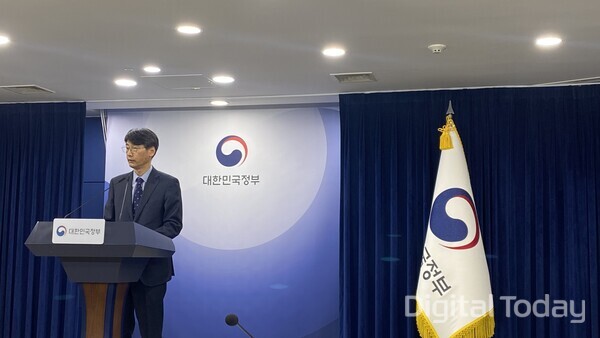
The Ministry of Science and ICT held a briefing at the Government Complex Seoul on Thursday and announced it had additionally selected the Motif Technologies consortium as an elite team for the Dokpamo project. Kim Kyung-man (김경만), head of the AI Policy Bureau, said, “We will concentrate all available national capabilities and resources to continue technological innovation competition so that South Korea can stand at the forefront of the global AI technology race.”
Dokpamo is a project to develop a domestic AI foundation model that the government launched in August last year. It is designed as a survival-style structure that picks competitive independent models through technology competition among companies, with the aim of securing AI sovereignty and autonomy in the security domain.
Five elite teams selected through the initial call went through the first stage, and 3 teams (LG AI Research·SK Telecom·Upstage) advanced in a January evaluation this year. The plan was initially for 1 team to be eliminated, but 2 teams were dropped after Naver Cloud was judged to have fallen short of originality standards by using weights from Alibaba’s Qwen model from China, and Motif Technologies joined through this additional selection. In an early August second-stage evaluation, 1 team will be eliminated and the field narrowed to 3 teams, and after additional evaluations, 2 teams will be selected in the end.
Motif Technologies, which joined through the additional selection, was highly rated for its experience achieving performance competitive at the global level in an AI model designed on the basis of its own architecture, even with relatively fewer parameters and in a limited data environment. As it promotes “pure independent design” that does not borrow the structure of foreign open-source models, it is pursuing a strategy to directly break through the originality standard that held back Naver Cloud in the first round. Specifically, it presented a goal of developing an independent model at a global top level by starting with a 300B-class inference LLM and then upgrading in stages to a 310B-class VLM and a 320B-class VLA.
With Motif Technologies joining, the second-stage schedule will be run differently by team. The 3 existing teams will complete development from January through the end of June, while Motif Technologies is guaranteed a development period from February through the end of July. The second-stage evaluation will take place around early August, after development by all 4 teams is completed. Motif Technologies will be provided support at the level of 768 Nvidia B200 GPUs, 1.75 billion won for data building and processing costs, and 10 billion won for joint data purchases and use, and it will also be granted the name “K-AI company.”
The principle is “the same period, the same GPUs, the same data,” but this reflects that the 3 existing teams have already been developing for several months. Kim said, “It is true that many good models are emerging these days, and we are quite tense,” adding, “We judge companies will pick up development speed, and additional supply of GPUs and data will also be made.”
A key issue is the criteria for judging originality. An independent AI foundation model as defined by the government is a model that is not fine-tuned from an overseas model or a derivative type, but a model that carries out the entire process in-house, from model design to pre-training. The minimum requirement is independently training and optimizing the model with weights in an initialised state.
Kim said, “In this additional selection evaluation, we looked at whether there is experience in developing an independent model and technical capability,” adding, “We will determine whether Motif Technologies’ 300B model actually meets originality requirements at the point when development is completed at the end of July.” He also added, “Together with the 4 teams, we will gather opinions from experts in industry and academia and quickly finalise detailed standards.”
The minimum originality standards currently presented by the government are 2 items: owning training data itself and having the ability to fix issues in-house when problems arise. However, there is an assessment that a grey area remains over how far these standards are applied in actual development settings.
Beyond performance, the feasibility of application at actual industrial sites is also emerging as an evaluation standard. Kim said, “Each consortium includes companies for industrial-site application as well as developers, and we will reflect an expandability item in the evaluation.” He did not disclose specific points allocation or evaluation methods.
In the briefing, Kim also stressed the development of an action model applicable to physical AI. He said, “For the other 3 teams as well as Motif Technologies, the top target is also an action model.”
 Seulgi Son
sageson@d-today.co.kr
Seulgi Son
sageson@d-today.co.kr