
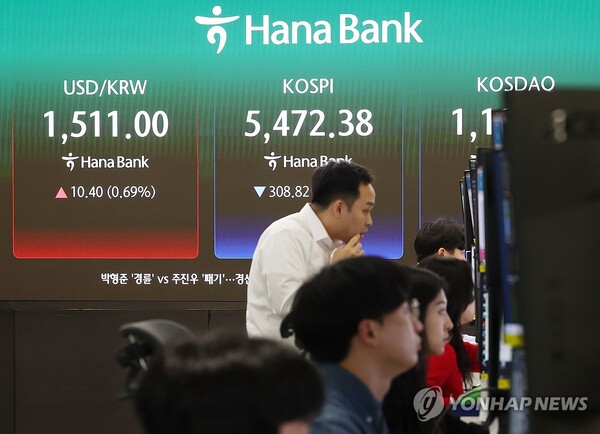
The won-dollar exchange rate climbed above 1,510 intraday for the first time in more than 17 years, affected by factors including a war in the Middle East.
As of 9:42 a.m. on March 23, the won was trading at 1,510.3 per dollar in the Seoul foreign exchange market, up 9.7 won from the previous session's onshore close (3:30 p.m.).
The exchange rate opened at 1,504.9, up 4.3 won, then quickly extended gains to hit as high as 1,511.8 in early trading.
It was the highest level since it rose as high as 1,561.0 intraday on March 10, 2009, during the global financial crisis.
After ending onshore trade at 1,501.0 on March 19 and 1,500.6 on March 20, the won-dollar rate pushed higher within the 1,500 range.
The dollar index, which measures the dollar's value against six major currencies, rose 0.29 percent from the previous session to 99.695.
Foreigners are net sellers of more than 1.16 trillion won worth of KOSPI shares.
Iran, at war with the United States and Israel, has blockaded the Strait of Hormuz, a key route for crude shipments, sending international oil prices sharply higher and lifting the dollar, a safe-haven asset.
The government is drawing up a supplementary budget to reduce the impact of the Middle East war on people's livelihoods and industry. The Democratic Party and the government and presidential office decided to set the size of the supplementary budget at around 25 trillion won, Democratic Party chief spokesperson Kang Jun-hyeon (강준현) said the previous day.
Tensions in the Middle East are escalating. U.S. President Donald Trump warned in a post on Truth Social on March 21 (U.S. local time) that "if Iran does not fully open the Strait of Hormuz without any threat within 48 hours from now, the United States will attack and completely eliminate Iran's various power plants, starting with the largest power plant."
Ebrahim Zolfaghari (에브라힘 졸파가리), spokesperson for Iran's Khatam al-Anbiya Central Headquarters, which exercises unified command of Iran's armed forces, hit back on March 22, saying, "If the U.S. threat targeting Iran's power plants is carried out, the Strait of Hormuz will be completely closed and will not be reopened until the power plants are rebuilt."
Reports also said the U.S. military has begun internal preparations for the possibility of deploying ground troops.
The yen-dollar exchange rate rose 0.64 percent to 159.371 yen.
At the same time, the won-yen cross rate was 947.51 won per 100 yen. It was down 0.05 won from the previous session's 3:30 p.m. reference rate.
[Yonhap News Agency]
 Online Team
d-today@d-today.co.kr
Online Team
d-today@d-today.co.kr