
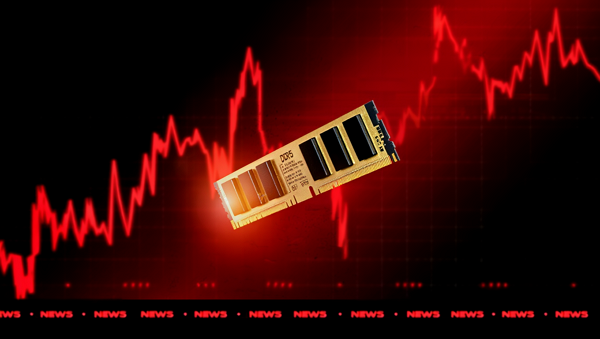
[DigitalToday Kyung-min Hong (홍경민), intern reporter] As soaring demand for AI data centres drives up memory (RAM) prices, a new hardware strategy is needed that prioritises graphics cards and monitors over the traditional formula of swapping out parts.
IT outlet TechRadar reported on Feb. 19 that as rapid growth in the AI industry pushes up GPU and SSD prices, RAM prices in particular have posted record spikes since last December.
With prices for high-spec DDR5 RAM rising to near the cost of some laptop bodies, the once low-cost approach of improving performance by adding RAM is no longer an efficient alternative. Users now face a need to manage hardware based on new priorities rather than past upgrade habits.
At present, the most efficient upgrade is replacing the GPU. Upfront costs may be higher than upgrading RAM or a CPU, but the real-world performance gains are the most pronounced. For users on older models, swapping to a latest-generation GPU can maximise gaming and work performance without replacing the entire system. If a high-performance graphics card sharply raises the system’s class, a bottleneck can force additional replacement of the CPU, power supply unit (PSU) and motherboard, so an appropriate choice is needed based on the system’s specifications.
If rising prices for internal components are burdensome, replacing the monitor is an alternative upgrade method. Unlike RAM, monitors are largely free of compatibility issues, and once purchased they can be used for a long period, making them an investment that carries forward. Compared with current RAM prices, display products have relatively larger discounts and are more accessible, and raising resolution or refresh rate by a step can improve the user experience beyond what a hardware performance expansion alone delivers.
A CPU upgrade is also an option, but users must consider the possibility of a chain replacement involving the motherboard and RAM. Most new CPUs require slots dedicated to DDR5 RAM, which can create a situation in which expensive RAM must also be purchased. Choosing a combination of a previous-generation chipset motherboard and CPU that can keep using existing DDR4 RAM can be a reasonable strategy for cutting costs. That is a practical solution for users who prioritise budget efficiency over high-end performance.
Storage devices such as SSDs are also likely to rise further in price due to AI hardware demand. Experts recommend that users currently using low-capacity storage of less than 1 terabyte should secure more capacity before prices rise further. Other supplementary upgrades mentioned as relatively inexpensive include replacing the PSU for long-term system stability and replacing the case to improve cooling efficiency.
In conclusion, the hardware supply-demand imbalance driven by the spread of AI technology has completely changed the rules of the PC build market. Experts stressed that users should closely watch component price trends tied to technological change and manage their systems based on strategic priorities that consider compatibility and budgets rather than simple specification upgrades.
 Kyung-min Hong
hongm@d-today.co.kr
Kyung-min Hong
hongm@d-today.co.kr