
KT is strengthening what it calls practical AI competitiveness by applying its artificial intelligence research results to actual services and linking technology with business.
KT said on Saturday that it is moving beyond simply accumulating research results and reflecting secured technologies in major AI models and platforms such as "Mi:um K" and "Agentic Fabric" to deliver commercialisation results.
KT has published a total of 148 AI papers over the past 5 years. Of those, 49 were listed at top global conferences such as CVPR, EMNLP, NeurIPS, ACL, ICCV, AAAI and others.
It has also formed joint research centres with major universities including Seoul National University, KAIST and Korea University. KT is conducting joint research that combines each university's research capabilities with KT's technology and business experience. It is also continuing cooperation with Microsoft Research to secure global-level technology.
KT has built a cooperation system that goes beyond simple technology exchanges and jointly considers everything from the research planning stage to performance verification and the potential for business application. KT explained that this is establishing a structure in which research results lead to actual services and business.
Since last year, it has expanded the scope of its industry-academia research cooperation to areas such as agentic AI, vertical AI, responsible AI and physical AI. It is applying its secured multimodal and agentic AI capabilities to commercial services such as Mi:um K and Agentic Fabric.
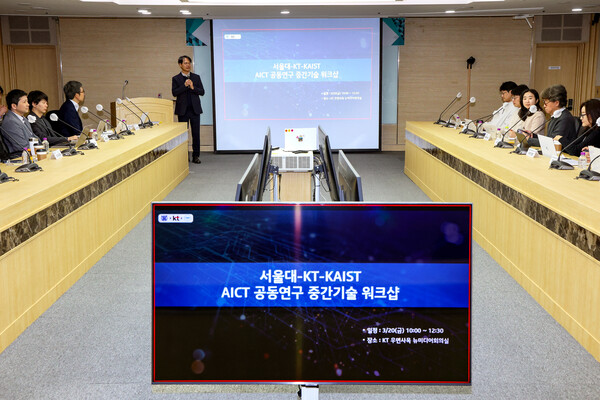
KT held a technology workshop on March 20 with Seoul National University and KAIST at the KT Umyeon Research Center in Seocho-gu, Seoul. Participants introduced the status of various joint research tasks, including efficient training and inference, next-generation interfaces and responsible AI. They also discussed ways to link research results to actual technology and services.
Jae-wook Lee (이재욱), head of the Seoul National University AI Institute, said the joint industry-academia research consists of research tasks that consider academic depth and industrial applicability at the same time. He said it is becoming a meaningful case in which university research results lead to corporate problem-solving and service innovation.
Seung-pil Oh (오승필), head of KT's Technology Innovation Division and a vice president, said it will continue to secure core next-generation AI technologies pre-emptively through a roadmap and industry-academia cooperation that organically connects technology research and products. He said the company will keep strengthening AI competitiveness that works in industrial settings.
 Jin-ho Lee
jhlee26@d-today.co.kr
Jin-ho Lee
jhlee26@d-today.co.kr