
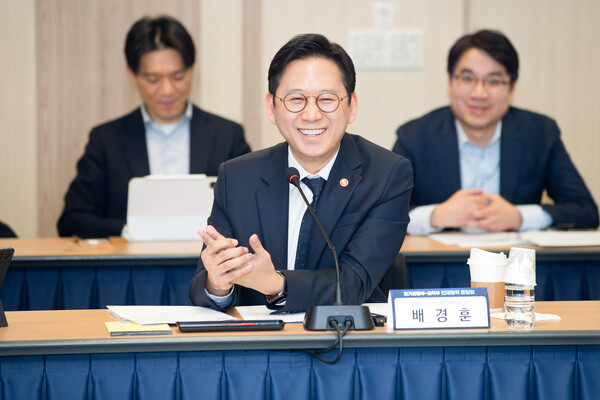
South Korea's Ministry of Science and ICT and the Education Ministry will cooperate as a "one team" across the full education cycle to train talent for the artificial intelligence (AI) era. They plan to form a task force led jointly by the two ministries' vice ministers and finalise a five-year basic plan by June.
Bae Kyung-hoon (배경훈), deputy prime minister and minister of science and ICT, and Choi Kyo-jin (최교진), education minister, held a "talent policy discussion meeting" on March 19 at the National Science and Technology Advisory Council.
The two ministries agreed that they need to respond jointly to structural social changes including a declining school-age population and advances in AI technology. To push policies forward at speed, they decided to form a task force led jointly by the vice ministers.
On fostering AI talent, the ministries will build an AI hands-on training platform at the elementary and secondary education level so students can directly handle real data and AI models. They will prepare guidelines for using generative AI and provide AI ethics education, and will also promote training to strengthen teachers' capabilities.
At the university level, they will expand joint research, credit exchanges and access to strong courses among AI colleges at science and technology institutes, AI-focused universities and the Education Ministry's AI hub universities to build a region-based talent training system. They will also pursue development of customised AI education content for the entire population and expansion of participation in AI competitions.
To foster talent for balanced regional development, the ministries will also strengthen cooperation among science and technology institutes, government-funded research institutes and national hub universities. Linked to a "five hubs and three special zones" growth strategy, they will operate joint research and cooperation programmes among the institutions and promote concurrent appointments to facilitate personnel exchanges.
They also decided to link the science ministry's direction for improving policies and systems for joint use and management of research equipment with related Education Ministry projects to promote shared use of university research facilities and equipment. The aim is to expand the operation of dedicated equipment personnel.
Based on the results of the discussions, the ministries plan to prepare detailed cooperation plans, submit them to the ministerial meeting on science and technology-related affairs in the first half of this year, and finalise the Fifth Basic Plan for Fostering and Supporting Science and Technology Talent by June.
Bae said that with advanced technology development accelerating around AI and the global industrial order being rapidly reshaped, this is a "golden time" for talent policy. He added that the two ministries will cooperate as one team to build an innovative ecosystem for fostering talent for future generations.
Choi said he will join forces with the science ministry to foster talent across the entire life cycle, from elementary and secondary education to higher and lifelong education.
 Jin-ho Lee
jhlee26@d-today.co.kr
Jin-ho Lee
jhlee26@d-today.co.kr