
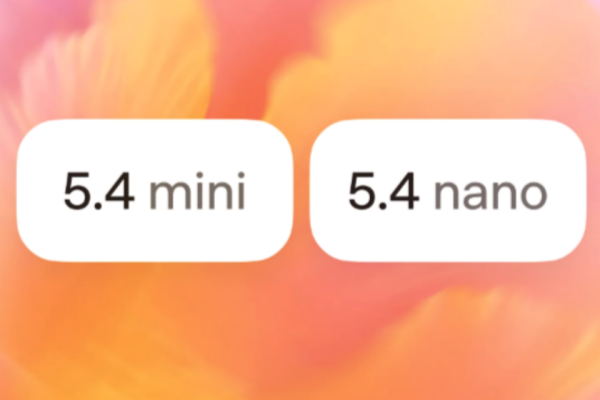
[DigitalToday reporter Jinju Hong (홍진주)] OpenAI unveiled the lightweight GPT-5.4 mini and GPT-5.4 nano versions of GPT-5.4, allowing free users to use models based on 'Thinking'.
Tech outlet TechRadar reported on March 18 that the GPT-5.4 Thinking model, which has advanced reasoning capabilities, had been offered only to paying subscribers such as Plus or Pro. With this update, users on free and Go plans can also use the feature.
The way it works is simple. Instead of directly choosing GPT-5.4 mini or nano in ChatGPT's model picker, users select the 'Thinking' option and those models run in the background. In other words, it looks like the same ChatGPT on the surface, but a higher-level reasoning model is applied in practice.
The Thinking model stands out on tasks that require multi-step judgment rather than simple question-and-answer. For example, when asked to "design a five-day Europe trip that includes three specific cities while minimizing travel time," a general model focused on listing itineraries and transport methods for each city. The Thinking model went beyond presenting a schedule, rearranging the city order with travel routes and time efficiency in mind and explaining why it chose planes or trains.
It showed a concrete decision-making process, not just telling users "where to go" but why visiting a city first reduces travel time and how choosing certain transport changes cost and time.
A clear difference also appeared on complex questions such as monetisation. Given the conditions of "10,000 pounds in capital, no coding experience, and a plan to generate online income within six months," the general model offered an outline that mainly listed possible methods. The Thinking model, by contrast, presented a structured execution strategy to meet the goal.
In particular, it split the plan into running 'Track A' aimed at short-term income alongside 'Track B' to build assets that can scale over the long term. It explained schedules and expected risks in detail by stage. For instance, it proposed activities that could secure quick cash flow early on while also designing a strategy to build a structure where income accumulates over time.
A notable point is that performance does not fall much despite the smaller models. GPT-5.4 mini and nano are classified as lightweight models, but the actual output often did not differ greatly from the higher-end GPT-5.4. Reviews say response speed is faster, and perceived performance differences are not large in everyday writing or problem solving.
By contrast, the full GPT-5.4 Thinking model on the Plus plan provides deeper analysis and additional thought processes, but it has the drawback of longer response times. As a result, the mini and nano models can be seen as closer to a practical balance point that secures speed and efficiency at the cost of a little depth.
This update is meaningful in that it goes beyond a simple feature addition and greatly expands access to advanced AI capabilities. As advanced reasoning that had been limited to paying users is now partly provided to free users, one analysis says the way people use AI itself is likely to expand by another step.
 Jinju Hong
hongjj@d-today.co.kr
Jinju Hong
hongjj@d-today.co.kr