
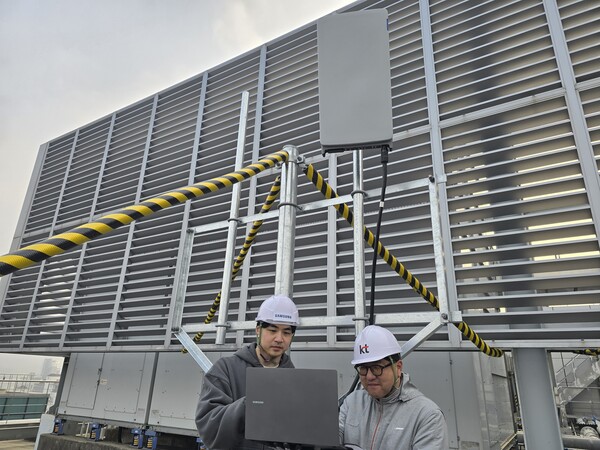
Samsung Electronics said on Thursday it, KT and Keysight Technologies succeeded in verifying an ultra-high-density multi-antenna technology in the 7 GHz band, a core frequency for 6G communications standards. The technology integrates multiple antennas into a single system to maximise signal efficiency and increase data throughput. It also achieved an industry-leading maximum downlink speed of 3 Gbps, about 2 times faster than 5G, in the 7 GHz band.
Samsung Electronics developed a prototype base station applying the ultra-high-density multi-antenna technology. It conducted the verification using Keysight's 6G test device in a communications environment built by KT to resemble real conditions. Researchers succeeded in reaching a maximum downlink speed of 3 Gbps when transmitting data from the base station to a user device.
The 7 GHz band is a key candidate frequency for 6G attracting industry attention. It offers wider bandwidth than the commercialised 5G 3.5 GHz band and can be expected to deliver faster data transmission speeds. As frequencies rise, communication signals are more easily disrupted by obstacles and coverage also shrinks. Ultra-high-density multi-antenna technology is essential to address this.
Samsung Electronics, KT and Keysight conducted verification in the 7 GHz band by simultaneously transmitting 8 data streams from a base station using ultra-high-density multi-antennas to a user device. It logged a maximum downlink data transmission speed of 3 Gbps, about 2 times faster than 5G. The company said the result is expected to contribute to implementing 6G communications across various fields such as AI and XR, where data demand is rapidly increasing.
Jin-kook Jeong (정진국), head of Samsung Electronics' Advanced Communications Research Center, said, "Through cooperation with KT and Keysight, we were able to confirm the possibility of improving transmission speeds in next-generation communications." He said, "We will continue to take the lead in securing future network technologies so that various services and user experiences in the 6G era can be realised."
Jong-sik Lee (이종식), head of KT's Future Network Research Institute, said, "This verification is an important turning point in preparing for 6G commercialisation, and by securing stable, high capacity in the 7 GHz band we have established the key foundational technologies needed to realise ultra-fast and immersive services." He added, "We will continue future network innovation together with Samsung Electronics."
Kailash Narayanan (카일라쉬 나라야난), president of Keysight's Communications Solutions Group, said, "Based on this result, we have bridged the gap between research and commercialisation." He said, "Together with Samsung Electronics, we will contribute to innovation in next-generation wireless communications technologies and enhance customer value."
 Dae-geon Seok
d2dg@d-today.co.kr
Dae-geon Seok
d2dg@d-today.co.kr