
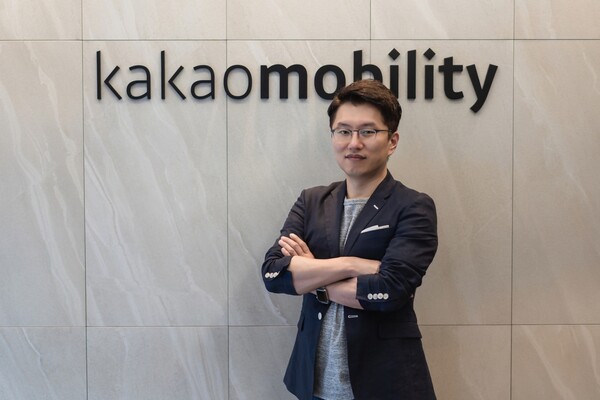
Kakao Mobility is stepping up its shift beyond a mobility platform into a robotics company. CEO Ryoo Geung-seon (류긍선) recently declared in a CEO letter to employees that it is a “technology company leading the era of physical AI” and put securing technology sovereignty at the forefront. The target is robotics.
According to KDI, the government set a goal in its fourth basic plan for intelligent robots to expand the K-robot market to more than 20 trillion won by 2030. With the 100 trillion won AI investment that began after the launch of the Lee Jae-myung government spreading into physical AI, platform technology that can efficiently manage and control robots is emerging as a key competitive factor.
Kakao Mobility put that platform competitiveness forward as an asset. In the CEO letter, Ryoo listed 4 core assets of the company.
They are a data quality system refined to the level of AI training, map and road network data that reflects changes on real roads, operational standardisation capabilities that standardise operating variables from dispatch to settlement, and hub infrastructure that determines a service’s economic viability and scalability. These asset groups were accumulated in the mobility industry’s digital transformation process, but Kakao Mobility is redefining them as the foundation for its robotics business.
The technical link applies the idea of replacing vehicles with robots, based on the point that controlling many autonomous vehicles and controlling many robots are essentially the same structure. Kakao Mobility in fact expanded the application of its demand-supply forecasting algorithm based on a transport management system to robot dispatch from autonomous driving dispatch. Its business expansion path runs from mobility to autonomous driving, from autonomous driving to robotics, and then to the physical AI ecosystem.
Kakao Mobility said it established a commercial model for robot deliveries at premium hotels such as Shilla Stay Seocho and Banyan Tree Club & Spa Seoul in cooperation with Robotis. It said average daily robot utilisation rose about 8-fold after the platform was introduced and the delivery success rate reached 100 percent. At hotels that combined a QR-based ordering system, room service sales rose about 3-fold, also proving the potential as a “profit model.”
It is noteworthy in that it was not a simple introduction of robots, but an orchestration structure in which the platform integrates control of heterogeneous robots and optimises dispatch. Kakao Mobility is also expanding cooperation with LG Electronics, Bear Robotics and others and is presenting a roadmap for expansion into hospitals, offices and logistics.
Robotics platform commercial model proven... 'orchestration' structure is the differentiator
Autonomous driving is also serving as the technical foundation for the shift to robotics. Kakao Mobility was selected as an operator for Seoul’s autonomous vehicle project for late-night Gangnam from this week and began operations based on its own technology. It also set up a physical AI division led by Vice President Kim Jin-gyu (김진규), a former Waymo executive, and began working to internalise end-to-end autonomous driving technology.
The robotics direction is clearer when looking at Kakao Mobility’s position in the M.AX Alliance, led by the Ministry of Trade, Industry and Energy as a flagship project. It is participating as an anchor company alongside Hyundai Motor (completed vehicles), LG Electronics and Hyundai Mobis (SDV), and Naver Cloud (IT), but its differentiator is that it holds platform operation, control and data at the same time. Kakao Mobility is neither a robot manufacturer nor a pure IT company, but plays the role of designing an operating structure in which robots produce actual results.
Its overseas expansion is along the same lines. Kakao Mobility signed a proof-of-concept contract for an integrated mobility solution for Saudi Arabia’s Diriyah project, and the contract specified the possibility of smart city cooperation such as robot deliveries. It is a path in which domestic robotics demonstrations lead to overseas technology exports.
Kakao Mobility’s ultimate position is a platform hub for the robotics ecosystem, not robot manufacturing. Whether it can expand into robotics based on the autonomous driving datasets it has accumulated will be a key issue. An industry official assessed that it is important how a robot platform model can be provided to fit domain areas such as hospitals, logistics and housing. Ryoo earlier said, “We will keep open the possibility of cooperation, but will not rely only on external parties for core capabilities and leadership, and will secure unrivalled technology sovereignty optimised for our environment.”
 Seok Dae-geon
d2dg@d-today.co.kr
Seok Dae-geon
d2dg@d-today.co.kr